How do you write an FAQ so an answer can be taken from it?
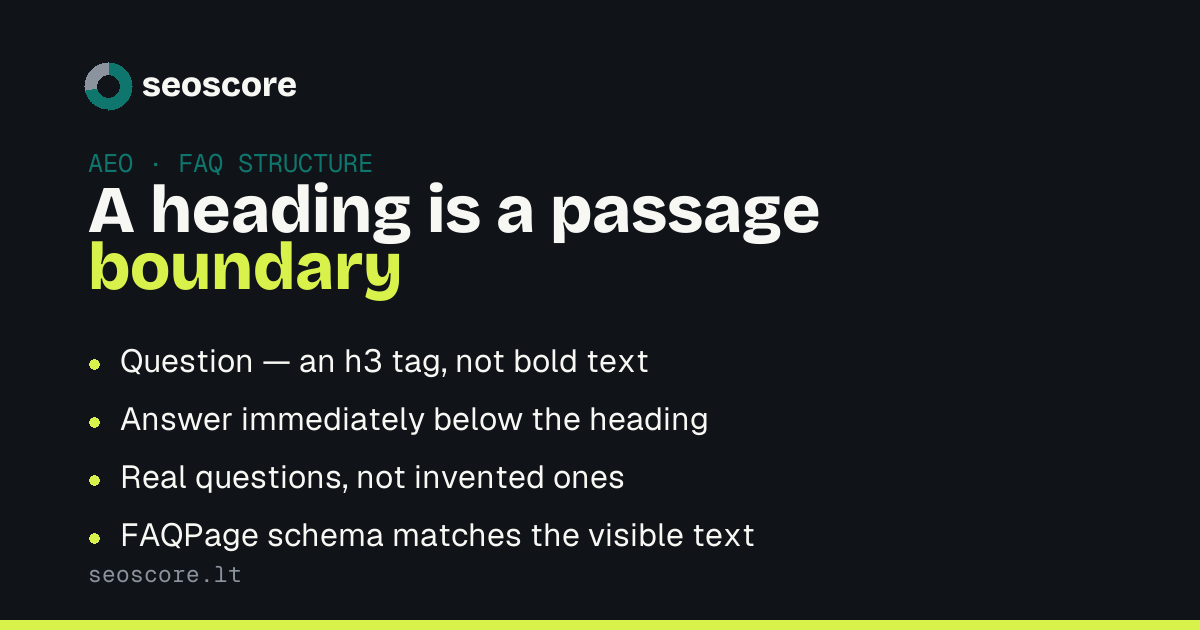
Every question must be a real heading (h3), with the answer immediately below it. Headings are passage boundaries: without them a twenty-question block is one large text, and a model cannot cut out the answer to a single question.
The FAQ section is the most commonly broken block on a website. The reason is technical rather than stylistic: the questions get written in bold text instead of a heading tag.
On screen there is no difference. To a model and to search, the difference is everything.
Why the heading matters
A model does not read a page top to bottom. It splits it into passages, and headings are those boundaries. A block without them is one passage.
A twenty-question FAQ with no headings is one chunk of roughly three hundred words. Ask one of those questions and the model either takes the whole chunk or takes nothing, because the answer to one question is not in there as a unit.
With headings the same block becomes twenty separate passages, each answering its own question.
How to do it properly
Question — h3 (or h2 if the FAQ is the whole page). Answer — a paragraph
immediately below it.
If you use a disclosure widget, the heading can live inside it:
<details>
    <summary><h3>How long does an audit take?</h3></summary>
    <p>The automated part takes minutes.</p>
</details>
The specification allows this directly: the content of summary is either
phrasing content or one heading element.
Which questions to write
Real ones. The ones arriving by email or showing up in Search Console queries. Nobody searches for invented questions, so they match no query.
Awkward ones. "How much does it cost", "can I cancel", "what do you not do". Those close actual doubts instead of repeating marketing lines.
Ones with short answers. An FAQ is not a place for an article. Two to four sentences; if it needs more, that is a page of its own.
About the schema
FAQPage schema has to match what is visible on the page — that is a Google
requirement, not a suggestion. Schema carrying questions that do not appear on
screen is a violation.
A rich result from it is now rare: Google heavily restricted showing it. But it still has value for structure and for models, so it is worth adding — just not for the snippet.
Related articles
The same subject from another angle — each answers its own question:
- What is AEO and how to get into the answer
- How to get into Google's featured snippet
- How AI decides which sources it cites
How we measure this is described under what we check.
Sources
What this text rests on — primary sources, not retellings:
Frequently asked
How many questions should I include?
As many as people actually ask. Three real questions are worth more than twenty invented ones — the latter only dilute the page and read as filler.
Does the FAQ need its own page?
Not necessarily. Questions about a specific service belong on that service's page: there they answer the doubt at the moment it appears. A separate FAQ page suits general questions about the company.
Does a collapsible block hurt?
No, as long as the text is in the HTML. It hurts when the answer is loaded by JavaScript only on click — then it is not in the crawler's response at all.
Can I repeat the same question on several pages?
Better not. The same question with the same answer at several addresses is cannibalisation: Google picks one, and not necessarily the one you wanted.
Check yours
A free scan shows which of the things described here your site already does, and which it does not.