Which Schema.org structured data types does a website actually need?
Structured data is a JSON-LD block that repeats your page content in a form machines can read. In practice you need four types: Organization, WebSite, BreadcrumbList and a page type — Article, Product, Service or FAQPage. The remaining Schema.org types do nothing for most sites.
A search engine and a language model read the same HTML but look for different things. A human is fine with a page that says "call us on 555-0100". To a machine that is just a string: it cannot tell a phone number from an order reference.
Structured data answers that question. The same content appears a second time
— in a JSON-LD block where every fact has a name.
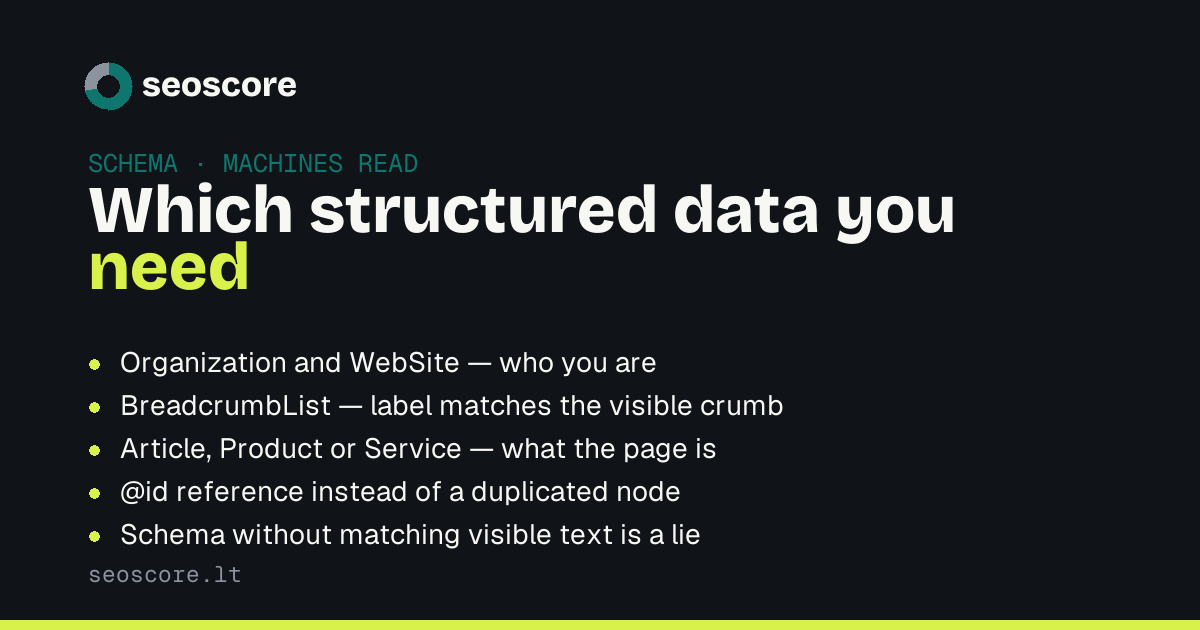
Four types are enough
Organization — who you are. Name, logo, contact details, sameAs links
to your profiles. This is the one node a model uses to connect your site with
whatever it already knows about you from elsewhere.
WebSite — the site as a whole. Name and language. Short, but without it
Organization hangs without context.
BreadcrumbList — the path to the page. The one type Google shows in
results almost every time: instead of a long URL the listing reads "Home ›
Services › Audit".
A page type — Article for writing, Product for goods, Service for
services, FAQPage for questions. This says what to look for on the page at
all.
That is it. Event, Recipe and JobPosting matter when you actually have an
event, a recipe or a vacancy — not because they exist in the catalogue.
The mistake almost everyone makes
Schema with no visible equivalent on the page is a lie told to a machine.
FAQPage with questions nobody can see. AggregateRating with a score nobody
gave. A Product price that differs from the one on screen.
Google penalises this separately, and that is not theory — it is written plainly in their structured data guidelines. But the more serious consequence is different: a model that catches one mismatch stops trusting the rest of your markup.
One rule: content first, markup second.
@id — a reference, not a copy
If an article and the site share an author, there is no need to describe them
twice. One node gets an @id, the other points at it:
{ "@type": "Article", "author": { "@id": "https://example.com/#org" } }
This is how Yoast, RankMath and every serious generator writes it. Two copies drift apart sooner or later, and then the machine sees two different authors for one text.
There is a practical consequence for auditing tools: checking whether an author is declared means following the reference, not looking for a full node in place. Our own audit once failed to do that and told eight perfectly correct articles their author was missing.
What this gives you for GEO
Classic SEO gets rich results out of schema — stars, prices, breadcrumbs. That is visible, but it is not the biggest gain.
A language model gets something else: certainty. When it has to name who provides a service in a given city, it chooses between pages where the fact has to be inferred and a page where it is declared. Declaration wins, because it needs no interpretation.
That is the same logic that makes llms.txt worth having at all: less work for the machine reading your page.
How to check
Google's Rich Results Test shows whether the markup is valid and which features it unlocks. The Schema.org validator shows whether the syntax is correct at all. Both are free and both take a minute.
The free scan checks something broader: whether schema exists, whether
it matches the visible text and whether @id references lead anywhere.
Related articles
The same topic from another angle — each answers its own question:
- What AEO is and how to land in the answer
- What llms.txt is and whether you need it
- How AI decides what to cite
How this feeds into the score is described under what we check.
Sources
What this text is based on — primary sources, not retellings:
Frequently asked
JSON-LD, Microdata or RDFa?
JSON-LD. Google recommends it directly, it lives in its own block and does not tangle with your HTML — so you can change it without touching the layout.
Does schema improve rankings?
Not directly. It unlocks rich results and helps machines understand the page, but it is not a ranking factor. Claiming otherwise is marketing.
How many schema types per page?
As many as the page actually contains. An article with questions legitimately carries `Article` and `FAQPage`. Five types on one page almost always means at least three do not match the content.
Do I need `AggregateRating`?
Only if the ratings are real and visible on the page. An invented rating is exactly the violation that gets rich results disabled for the whole site.
Check yours
A free scan shows which of the things described here your site already does, and which it does not.