Which GEO and AI SEO claims are myths?
The ten most common GEO myths are these: llms.txt is supposedly required, GEO will supposedly replace SEO, a model can supposedly be fooled with keywords, Google search will supposedly drop 25 percent, a page supposedly needs 1000 to 1500 words, content written with AI is supposedly already GEO, blocking every AI crawler is supposedly safest, FAQPage schema will supposedly earn a rich result, the result can supposedly be guaranteed, and ranking is supposedly the same as being cited. None of them survive a check against primary sources.
The GEO market is young, so there are many claims and few checked ones. Below are the ten you hear most often, each with what is actually true and where that is written down.
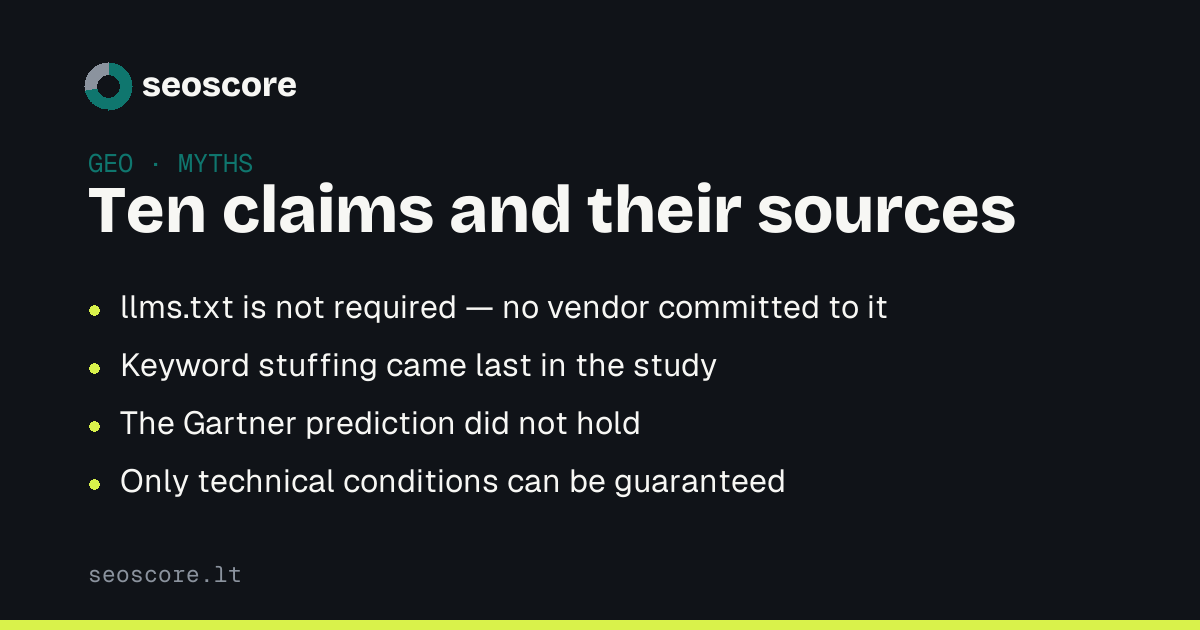
"llms.txt is required"
It is a proposal, not a standard. llmstxt.org describes it as an idea, and no
model vendor has publicly committed to reading the file.
Adding it is cheap and harmless. But a service whose main deliverable is an
llms.txt is a service without a deliverable. What matters more is that
robots.txt does not block answer crawlers.
"GEO will replace SEO"
Some models use the ordinary search index for answers: Google AI Overviews directly, ChatGPT and Perplexity through a search tool. So an unindexed site stays invisible to AI as well.
GEO is a layer on top of SEO, not a substitute for it. Starting with GEO while pages are not being indexed is not possible.
"A model can be fooled with keywords"
This is the one myth that has been measured directly. Research from Princeton and Georgia Tech, presented at KDD 2024, compared nine ways of editing text and checked how each changed visibility in generative search.
The biggest gains came from statistics, quotations and cited sources — up to 40 %. Keyword stuffing came last. A model does not rank pages, so keyword density means nothing to it.
"Google search will drop 25 %"
This number is still quoted in proposals. Its source is real: in February 2024 Gartner published a prediction that search engine volume would fall 25 % by 2026 because of AI chatbots.
It is now September 2026, and no such drop has happened. Search changed in a different way: the answer often arrives without a click, so what falls is the share of clicks rather than the number of searches. That is a real shift, but it is about clicks, not about the death of search.
A prediction is not a fact, even when a well-known firm published it.
"A page needs 1000 to 1500 words"
There is no general number. What matters to a model is not page length but how many words sit in one passage between headings, and there the useful range is 40 to 120.
Chasing a word count produces the opposite result: padded text dilutes the answer, and a model picks the precise passage.
"Content written with AI is already GEO"
That is text production, not GEO. It often works against it: models do not rely on text they have already seen dozens of times in different words.
GEO work is how a page is assembled — headings, passage length, schema, crawler access. What the text was written with decides nothing here.
"Blocking every AI crawler is safest"
Crawlers come in two kinds. Blocking training crawlers (GPTBot, ClaudeBot,
Google-Extended, CCBot) is a legitimate copyright decision. Blocking answer
crawlers (OAI-SearchBot, ChatGPT-User, Claude-User, PerplexityBot) means
your text will not be in AI answers.
Closing all of them with one line is the most common mistake in a robots.txt
file. More on that in should I block AI crawlers.
"FAQPage schema will earn a rich result"
It used to, until 2023. In August 2023 Google announced that FAQ rich results
would be shown only for authoritative government and health websites, and
removed HowTo entirely.
That does not make FAQPage pointless. It still has value for structure and
for models, but it should be added for that reason rather than for a snippet in
search results.
"The result can be guaranteed"
It cannot, and the reason is technical. A model's answer is not a ranked list: it is assembled anew each time, it depends on how the question is phrased and on the model version, and no vendor publishes the schedule on which its data is refreshed. The same question can give two people different answers on the same day.
What can be guaranteed is the technical conditions: that answer crawlers are allowed in, that structured data is valid, that pages answer questions, that passages are the right length. Those are verifiable and deliverable.
Whoever guarantees the citation itself, or a "position in the AI answer", is guaranteeing something they do not control.
"Ranking and being cited are the same"
They are two different things. A ranking is a place in a list a person reads and chooses from. A citation is a piece of your text inside someone else's text, often with no click at all.
A page can rank first on Google and appear in no AI answer, if its text is not divided into passages. And the reverse: a cited page is not necessarily in the top positions.
Related articles
- How AI cites a page: GEO architecture
- How to measure whether GEO is working
- What is llms.txt and do you really need it
- Seven signs of a fake GEO specialist
The full list of checks is on what we check.
Sources
Frequently asked
Did the Gartner 25 % prediction come true?
No. Gartner published it in February 2024, and by September 2026 no such drop in search volume had happened. Something else changed: answers increasingly arrive without a click, so the share of clicks falls rather than the number of searches.
Is llms.txt really unnecessary?
It does no harm, costs little and may prove useful later. But it is not a standard and no vendor has committed to reading it. If a service's main deliverable is an `llms.txt`, it is worth asking what else was done.
Are AI SEO and GEO the same thing?
The market uses the terms interchangeably, and technically they cover one job: making sure a model can reach, understand and cite your site. AEO usually refers to answer blocks in search. The difference is mostly in the name, not the work.
What do I say if an agency guarantees citations?
Ask how they guarantee something whose data refresh schedule no model vendor publishes. An honest proposal guarantees the technical conditions and states how the result will be measured.
Check yours
A free scan shows which of the things described here your site already does, and which it does not.