How do you get into Google AI Overviews and how is it different from ranking?
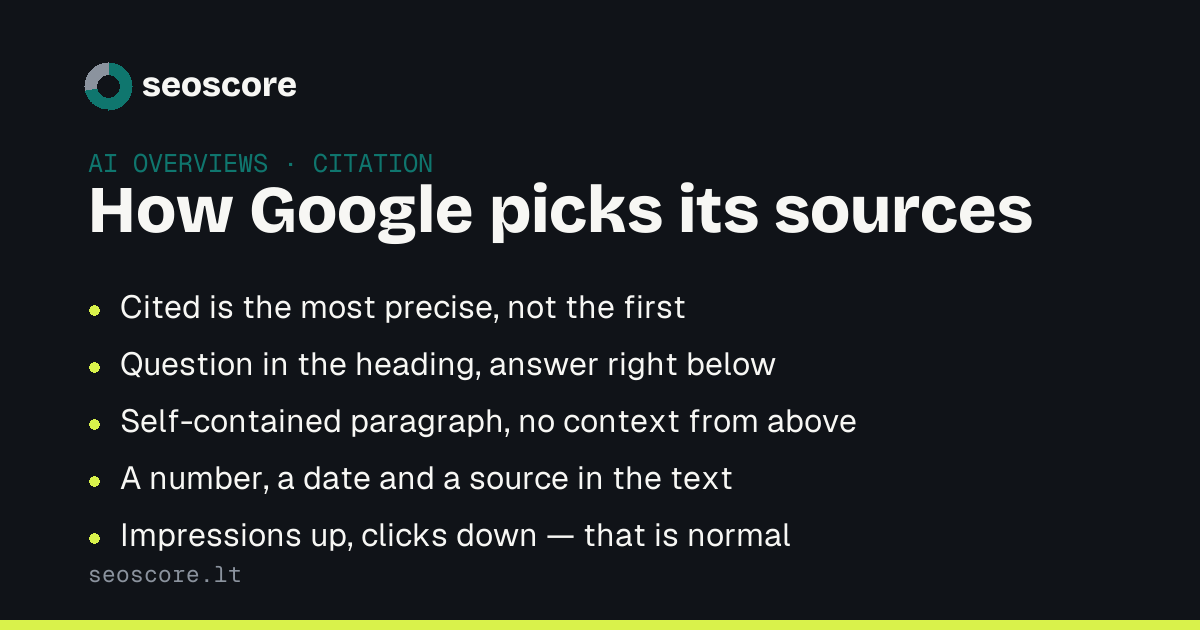
AI Overviews is a Google-generated summary at the top of the results that cites a handful of sources. What gets cited is not the page ranking first but the page holding a precise, self-contained paragraph answering one specific part of the question. A tenth-place page can be cited while the first place is not.
AI Overviews is a Google-generated summary that appears above every result. Beneath it sit a few links to the sources the summary was assembled from.
The most important fact about it: the list of cited sources does not match the top results. A page in tenth place can be quoted while the first result is not. That makes it a separate channel with its own rules, not a bonus awarded for good rankings.
Why one page gets cited and another does not
Google's summary does not need the best page, it needs the most usable paragraph. The question is split into parts, and for each part it looks for text that can be lifted without paraphrasing.
Three practical consequences follow.
The paragraph must stand alone. If it only makes sense after two sections above it, it is unusable. The model takes a fragment, not a document.
The question belongs in the heading. Not "Pricing", but "How much does a technical audit cost". Headings are the boundaries the text is split along — without them an entire section is one chunk, and no precise answer can be taken from it.
The answer comes immediately under the heading. One or two sentences, no preamble. If your answer starts in the fourth paragraph, nothing will be taken from it.
These are the same rules as AEO — the difference is only that AI Overviews cites several sources at once rather than one.
What raises your odds of being quoted
A concrete number with context. "An audit takes 2–4 hours" gets cited more often than "an audit does not take long". The model looks for what it can pass on without changing the meaning.
A date in the paragraph. A sentence saying when something held true is safer to cite — it can be presented with a caveat.
A link to a primary source. Text that itself rests on a document is easier to verify. That is not courtesy, it is checkability.
A table for comparisons. When the question is "what is the difference between X and Y", a table is taken almost every time — it is already shaped like an answer.
What it does to your traffic
The bad news, stated honestly: AI Overviews reduces clicks. People get the answer without clicking, and Search Console shows this as steady impressions with falling clicks.
The good news is real too. A click coming out of AI Overviews comes from someone who already read the answer and decided to visit anyway — those convert better. And a citation is visibility even without a click: your brand ends up in the answer, next to the question.
The conclusion is not "fight it". The conclusion is to change the unit of measurement — from clicks to citation frequency. How to measure that is under AI search and traffic.
What you do not need to do
You do not need separate content "for AI Overviews". Google states directly that there are no separate technical requirements: the same indexable page qualifies.
You do not need to compress everything into summaries. A page that is only answers with no depth loses the thing that keeps a visitor once they arrive.
You do not need to block Google-Extended hoping to "protect" your content. It does not remove you from AI Overviews — that uses the ordinary search index. What the flag actually controls is under should I block AI crawlers.
How to check your own page
Type your question into Google and see whether a summary appears at all. If it does — who is cited, and how does that paragraph differ from yours. The difference is usually the same one: theirs is a direct answer, yours is an introduction about why the topic matters.
The free scan checks the structural side: whether your pages carry questions with answers, whether the passages are the right length, whether headings actually divide the text, and whether schema matches what is visible.
Related articles
The same topic from another angle — each answers its own question:
- What AEO is and how to land in the answer
- How AI decides what to cite
- Google featured snippet: how to get into it
How this feeds into the score is described under what we check.
Sources
What this text is based on — primary sources, not retellings:
Frequently asked
Does AI Overviews appear for every query?
No. It is more common for informational questions and rarer where someone is clearly looking for a specific site or intending to buy.
Can I opt out of AI Overviews?
Partly. `nosnippet` and `max-snippet` limits apply to it, but the same markup also disables ordinary snippets in search — the cost is almost always higher than the benefit.
Does an AI Overviews citation count as a backlink?
Not in SEO terms. It is a link for the user, not a ranking signal. The value is visibility and the click, not link equity.
Why is my page cited one day and not the next?
The summary is generated per query and is not stable the way a ranking is. Ask the same question in different words and the source set changes.
Check yours
A free scan shows which of the things described here your site already does, and which it does not.