What do you do when AI answers take traffic from the site?
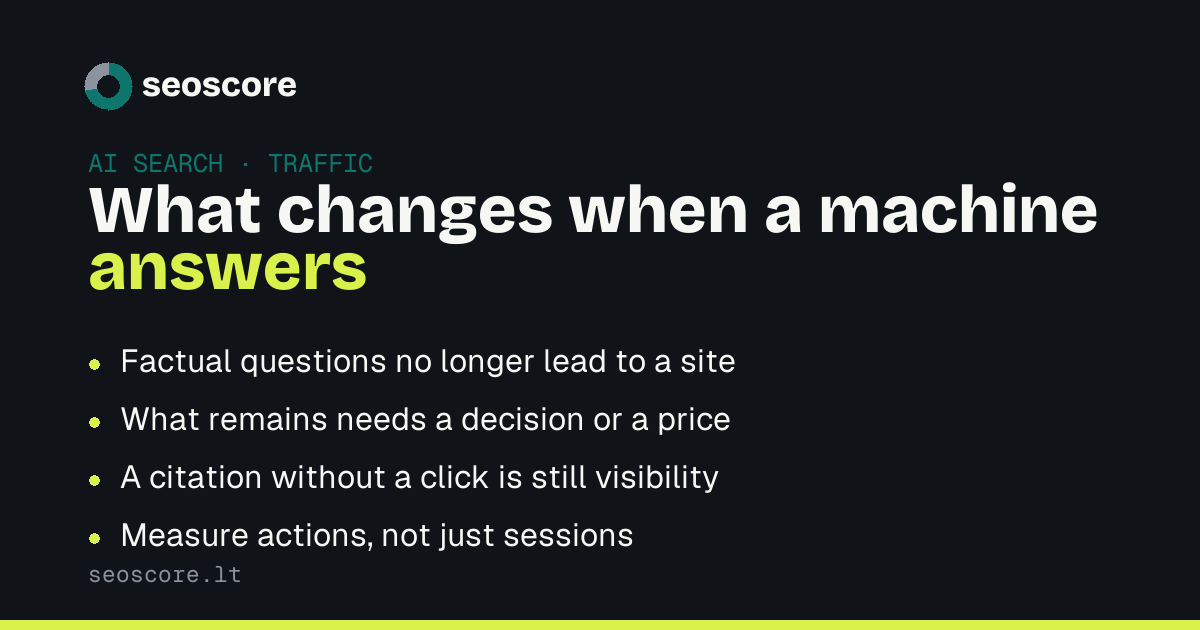
Short factual questions no longer lead to a website — the assistant answers them itself. What remains are the questions that need a decision, a price or an action. So the work moves from volume to precision: fewer visits, but closer to a purchase.
The number people fear is real: a share of searches ends without a single click, and with AI answers that share is growing. But it does not follow that traffic disappears — it follows that its composition changes.
Which visits go away
The first to go are short factual questions: "what are the opening hours", "what is a canonical", "what is the capital of". The answer fits in one sentence, so the assistant shows it.
Those visits were never worth much. Someone arrived, read one number and left — no conversion came from that.
Which visits remain
What remains are questions you cannot close in a sentence:
- comparison — "which option suits me" needs context the model does not have about you;
- price and terms — here a person wants to see the primary source;
- action — order, sign up, download, check something.
These were the valuable visits all along. Their share is now rising, because the background — incidental traffic — is thinning out.
Why a citation without a click still counts
A name in an answer is a name in an answer. The person sees it at the moment they are deciding, and comes back later — often straight through a brand search.
So track direct and branded visits separately. If those rise while overall traffic falls, the traffic has moved rather than disappeared.
What to actually do
Stop writing what one line answers. That content now competes with the assistant and loses.
Add what the model does not have. Your own numbers, your own measurements, your own cases. Text that exists nowhere else is the only kind that has to be cited with a link.
Measure actions, not visits. If scans, sign-ups or enquiries hold steady while sessions drop, the system is working better, not worse.
Related articles
The same subject from another angle — each answers its own question:
- How to get into ChatGPT and Gemini answers
- What is GEO optimization and how it differs from SEO
- Can ChatGPT see my website: how to check
- How to measure whether GEO is working
How we measure this is described under what we check.
Sources
What this text rests on — primary sources, not retellings:
Frequently asked
Should I block AI bots so they stop taking traffic?
It depends where your revenue comes from. If it comes from visits to the page, blocking may be right. If it comes from a service or product, blocking means disappearing from the answers that could have recommended you.
How do I see visits coming from AI?
Look in analytics for referrers `chatgpt.com`, `perplexity.ai`, `gemini.google.com`. The numbers will be small, but the trend is visible.
Does Search Console show AI answers?
Impressions from AI Overviews are folded into the overall Search Console figures, but there is no separate breakdown. Which is why average position now means less than it used to.
What do I do with old articles?
Merge the ones answering the same question, and deepen the ones answering it superficially. A short text with no data of its own is the first candidate to be replaced by an assistant's answer.
Check yours
A free scan shows which of the things described here your site already does, and which it does not.