What is GEO optimization, and how is it different from SEO?
GEO (Generative Engine Optimization) is preparing a website so that AI assistants — ChatGPT, Gemini, Perplexity, Claude — understand it, cite it and recommend it. It differs from SEO in its goal: SEO wants the click on your link, GEO wants your answer inside the text the person reads without clicking anything.
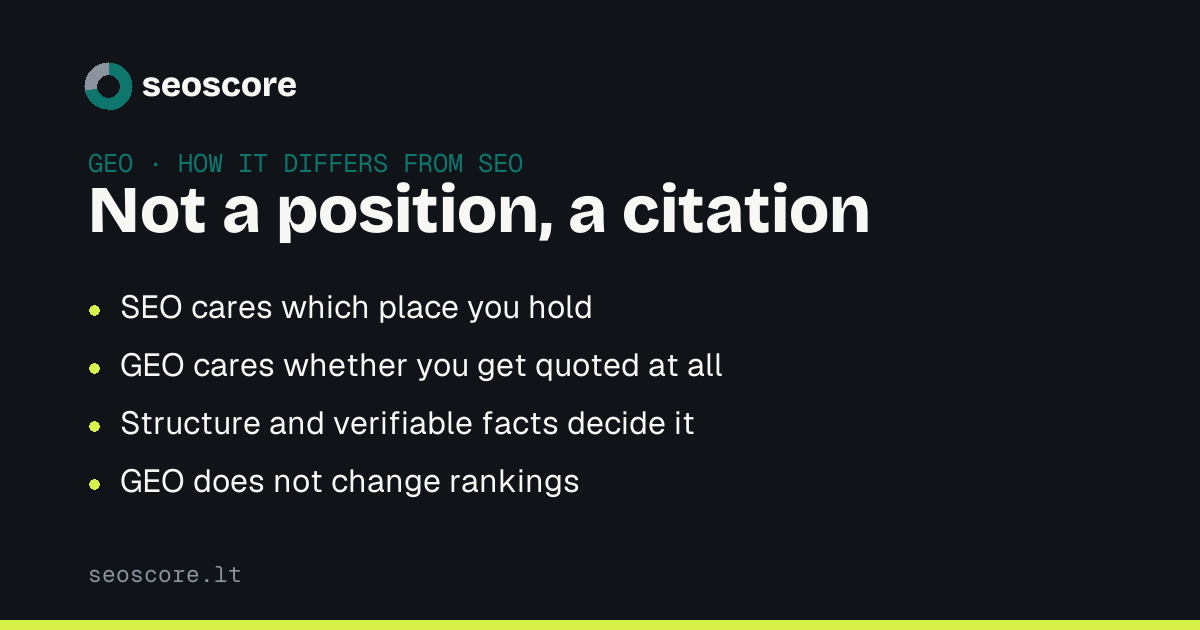
The difference sounds small, but it changes the whole order of work. SEO asks "how do we reach the first position". GEO asks "how do we end up in the answer, when nobody clicks the first position".
Why this appeared
Someone asking "what is the best SEO tool in Lithuania" increasingly gets a finished answer with three names and one link. If you are not in that list, your ranking no longer matters — nobody saw it.
This is not a forecast. Google AI Overviews sits above the organic results, and ChatGPT and Perplexity answer without a result list at all.
What GEO does differently
Content is written for the answer, not the keyword. A model does not pull a paragraph that repeats a keyword five times. It pulls the sentence that answers the question precisely.
Facts have to be checkable. A number with a source gets cited more often than a claim without one. "The average page loads in 2.5 s" is weaker than "across our 300 scans the average is 2.5 s".
Structure beats length. Question as the heading, answer immediately below, no run-up. The model needs to find the answer, not read the article.
Technical access is not optional. If robots.txt blocks GPTBot, nothing
else matters — the content is simply never read.
What GEO does not do
It does not replace SEO. Google organic search still brings most of the traffic for most sites, and the technical work — indexing, speed, structure — is shared by both. GEO is a layer on top, not a substitute.
It is also not a trick. You cannot fool a model with keywords: it does not rank pages, it assembles an answer out of what it understood.
Where to start
First check whether AI crawlers are allowed in at all — that is one
robots.txt file and five minutes. Then look at whether your pages answer
questions, or only describe services.
A free scan shows both at once: whether the bots get through, and whether the content is worth citing.
Related articles
The same subject from another angle — each answers its own question:
- What is AEO and how to win the answer
- Can ChatGPT see my website: how to check
- What is llms.txt and do you really need it
- How AI cites a page: GEO architecture
How this feeds into the score is described under what we check.
Sources
What this article is based on — primary sources, not retellings:
Frequently asked
Will GEO replace SEO?
No. The technical foundation — indexing, speed, structure — is shared, and organic search still brings the most traffic. GEO is an extra layer for those who also want to appear in AI answers.
How long until results show?
Technical changes (crawler access, structured data) take effect the next time a bot visits, usually within a day or two. Content changes show up when the model refreshes its data, which can take weeks.
Do I need an llms.txt file?
It does no harm and costs little, but no vendor has publicly committed to reading it. It matters more that `robots.txt` does not block AI crawlers and that the content is structured.
How do I check whether ChatGPT can see my site?
The simplest way is to ask it about your company and read the answer. The technical side shows up in a scan: whether `robots.txt` lets GPTBot in, whether pages carry structured data, whether the content answers questions.
Check yours
A free scan shows which of the things described here your site already does, and which it does not.