How does a website get into AI assistant answers?
You need three things at once: do not block AI crawlers in robots.txt, serve the content from the server without JavaScript, and structure the text so the answer to one question is one passage. A blocked crawler sees nothing, and empty HTML means an empty page to a model.
The question sounds like marketing, but the answer is technical. An assistant reaches your site by two routes — training data and live search — and the second is the one you can affect this week.
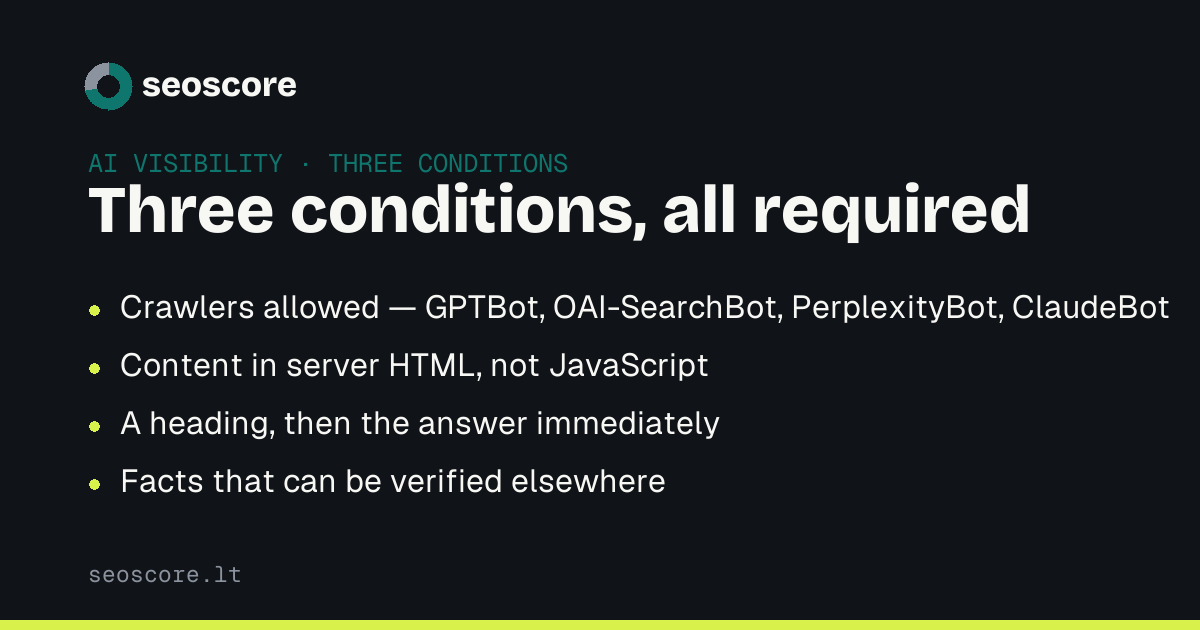
There are three conditions, and they run in order.
1. Let the crawler in
robots.txt is the first and usually the only obstacle. What matters is that
the crawlers differ in purpose:
GPTBot           OpenAI training data
OAI-SearchBot    ChatGPT search — THIS is what produces a link
ChatGPT-User     when a person asks it to open an address
ClaudeBot        Anthropic
PerplexityBot    Perplexity index
Google-Extended  Gemini and AI Overviews
Block all of them and you disappear from both answers and training. Block only the training crawlers and you stay in search but never enter the model's "memory". That is a decision, not a mistake — but it should be a deliberate one.
2. Serve the content from the server
Google executes JavaScript in a separate pass. Most AI crawlers do not execute
it at all: to them an empty <div id="app"> is an empty page.
You can check without any tooling — fetch the page the way a crawler does and see whether the text is there. If it is not, everything written below is measuring something the model never sees.
3. Make the answer separable
A model does not read a page from top to bottom. It splits it into passages and picks the one that answers the question. Headings are those boundaries.
Three practical consequences:
- question in the heading, answer immediately below — no preamble;
- 40–120 words per passage: shorter and there is nothing to quote, longer and the answer drowns;
- self-containment — the paragraph has to make sense lifted out of context, because that is exactly how it will be taken.
What is not enough
An llms.txt file does not create visibility on its own: no provider has
publicly committed to reading it. Worth having, not worth treating as the
solution.
Schema.org markup is not magic either. It helps explain what is on the page, but it does not make the content worth citing.
Related articles
The same subject from another angle — each answers its own question:
- Can ChatGPT see my website: how to check
- What is GEO optimization and how it differs from SEO
- Should I block AI crawlers: when it is worth it
How we measure this is described under what we check.
Sources
What this text rests on — primary sources, not retellings:
Frequently asked
How long until results show?
On the live search route, days to weeks, as the index refreshes. In training data, only with the next model release — months. Which is why you fix the second route first.
Can I buy a place in an answer?
No. There are no ad slots there, and anyone offering a guarantee is selling something they do not have. What you can influence is access, structure, and whether other sources corroborate your facts.
Do I need separate content for AI?
No. The same text, written with headings and direct answers, works for both the reader and the model. A separate version would drift from the main one within a month and start lying.
How do I know if I am already being cited?
Ask an assistant about your field and look at the links under the answer. The second way is to check your analytics for visits from `chatgpt.com` or `perplexity.ai`.
Check yours
A free scan shows which of the things described here your site already does, and which it does not.