Does the SEO score differ by industry?
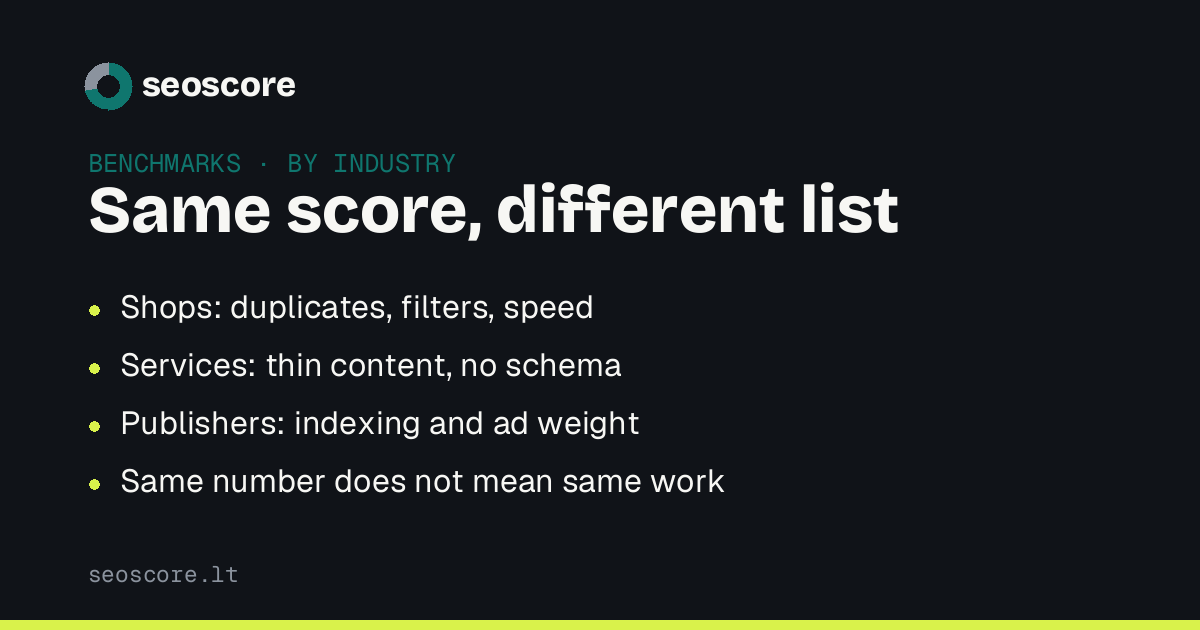
Scores differ less in size than in where they are lost. Shops most often lose points to duplicates, filter URLs and speed; service sites to thin content and missing structured data; publishers to indexing and third-party script weight. An identical number in these three means a different list of jobs.
"What score is normal in my industry" is a fair question, but a more useful answer is a different one: what matters is not how much is lost, but where.
The numbers draw on roughly 500 audits run on our earlier platform and on what we see today. The exports from that work are gone, so these are ranges rather than precise statistics.
Online shops
Usually land in the same 40–60 range, and almost always because of the same three things:
Duplicates and filter URLs. Every filter combination creates an address, and
there are more of them than products. Without canonical and clear rules the
index fills with variants nobody searches for.
Speed. A product page with a gallery, reviews and three scripts loads slowly on a phone. This is usually the single largest loss.
Product without offers fields. The node exists, but without price,
currency or availability — that is, without the reason it was added.
The good news: shops usually have the most easily recoverable points, because the problems are systemic and fixed once in a template.
Service websites
A similar range, but the losses sit elsewhere:
Thin content. Five pages of three paragraphs each. Google crawls such a page and leaves it unindexed — not because of an error, but because of value.
No structured data. Often not even a complete Organization.
No answers. A service description without a single question and answer, which is why the AI side falls further still.
There is less work here than it looks: usually a few main pages and an FAQ.
Publishers and content sites
Indexing. Many articles, a fraction indexed. Old ones drop out, new ones queue.
Ad weight. Speed suffers not because of the site but because of third-party scripts the newsroom does not control.
Article without author and dates. Exactly what credibility needs is what
is most often missing.
One-page sites
Small sites often score higher than large ones, simply because there is less to break. That does not make them more visible: the score measures technical state, not demand.
What to do with this
A comparison is only useful as a direction. The concrete list comes from a free scan, and how the number is assembled from the method.
Related articles
- What score a typical website actually has
- How the SeoScore 0–100 score is calculated
- Keyword cannibalization: how to spot it
- Why Google does not index my pages
What gets checked is listed under what we check.
Sources
What this text is based on — primary sources, not retellings:
Frequently asked
Is a lower score acceptable in a smaller market?
The score measures technical state, not competition. In a small niche you can be visible with a lower score, but the same fixes pay off faster there, because competitors have not made them either.
Why does my shop score lower than a simple blog?
Because it has more moving parts: filters, variants, galleries, scripts. A blog has little to lose points on.
Is it worth comparing my score to a competitor's?
Compare directions, not numbers. A competitor's score says nothing about what they earn; your own findings list says what you can fix this week.
Where are points recovered fastest?
In shops, because the mistakes are systemic: one template fix changes hundreds of pages at once.
Check yours
A free scan shows which of the things described here your site already does, and which it does not.