What SEO score is normal for an ordinary website?
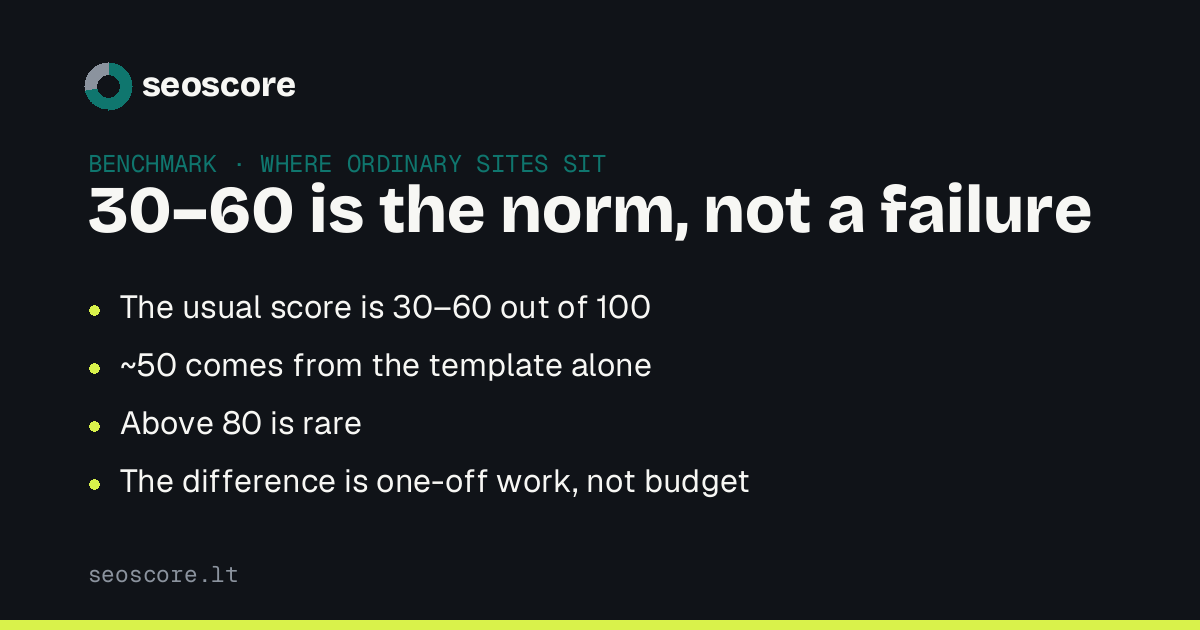
The usual score we see is between 30 and 60 out of 100. About 50 of that is already there on launch day — that is what a modern template gives you. Above 80 is rare, and it comes not from a bigger budget but from someone fixing indexing, headings, structured data and mobile speed once.
A score on its own means nothing. "62 out of 100" is good or bad only once you know what others hold and how much the site got for free.
The numbers draw on roughly 500 audits run on our earlier platform and on what we see today. The exports from that work are gone, so these are ranges rather than precise statistics.
Where sites usually sit
From what we see, the picture splits three ways:
30–50 — nobody ever owned the technical side. Usually not a neglected site: it looks fine, it has content, it may even have bought links. The technical work was simply never anyone's job.
50–70 — a site with a tidy template. Most sites are here. The template did
what it knows: HTTPS, a sitemap, robots.txt, a mobile layout. Everything
beyond the template stayed undone.
Above 80 — the few. And it almost always turns out that someone once sat down and closed the same short list over a few days.
Why the starting score is ~50
A freshly launched, tidy site scores about 50 having done nothing. That matters before judging any investment: if after two years the score is 60, roughly ten points were earned on the technical side.
It does not mean the money was wasted — links and content change what is outside the site, while the score measures what is inside it. It does mean the second half was never measured.
What fails most often
In order of how often we see it:
Indexing. Pages Google never accepted. "Discovered – currently not indexed" is the silent loss: no ranking, because there is no page.
Mobile speed. The desktop number looks fine, the phone number is several times worse, and most visitors are on a phone.
Structured data. Usually missing entirely, or a single Organization node
the template added.
Headings and meta. Titles too short for Google to keep, or identical across every page.
Internal links. Articles exist but connect neither to each other nor to the page that earns.
Why the top scores come from the same work
The interesting part: sites above 80 almost never do anything exotic. They simply finished the list — including the few items everyone else postpones.
More on that in what a site above 80 looks like.
Where to start
Find your own number first. A free scan returns the score and the findings holding it down, ranked by impact.
Then the same question on the AI side: the state of AI search.
Related articles
- What a site above 80 points looks like
- What score to expect in your industry
- How the SeoScore 0–100 score is calculated
- SEO in 2026: what is no longer enough
What exactly gets checked is listed under what we check.
Sources
What this text is based on — primary sources, not retellings:
Frequently asked
What counts as a good score?
Above 80 is genuinely good and a minority holds it. 60–70 means a tidy site with a few undone jobs. Below 45 usually means something is technically stuck rather than merely unpolished.
Does the score rise on its own if I publish articles?
Barely. Content raises coverage, while the score measures the technical state of the page. A new article on a bad template inherits every problem that template has.
How long does it take to go from 50 to 80?
Usually days rather than months, once the list is known. The slow part is not the fixing, it is deciding who owns it.
Does a small site need 80 too?
Not necessarily. A one-page site needs to be indexable, fast and carry `Organization` data. The score rises there on its own, because there is little to break.
Check yours
A free scan shows which of the things described here your site already does, and which it does not.