What state is SEO in across ordinary websites?
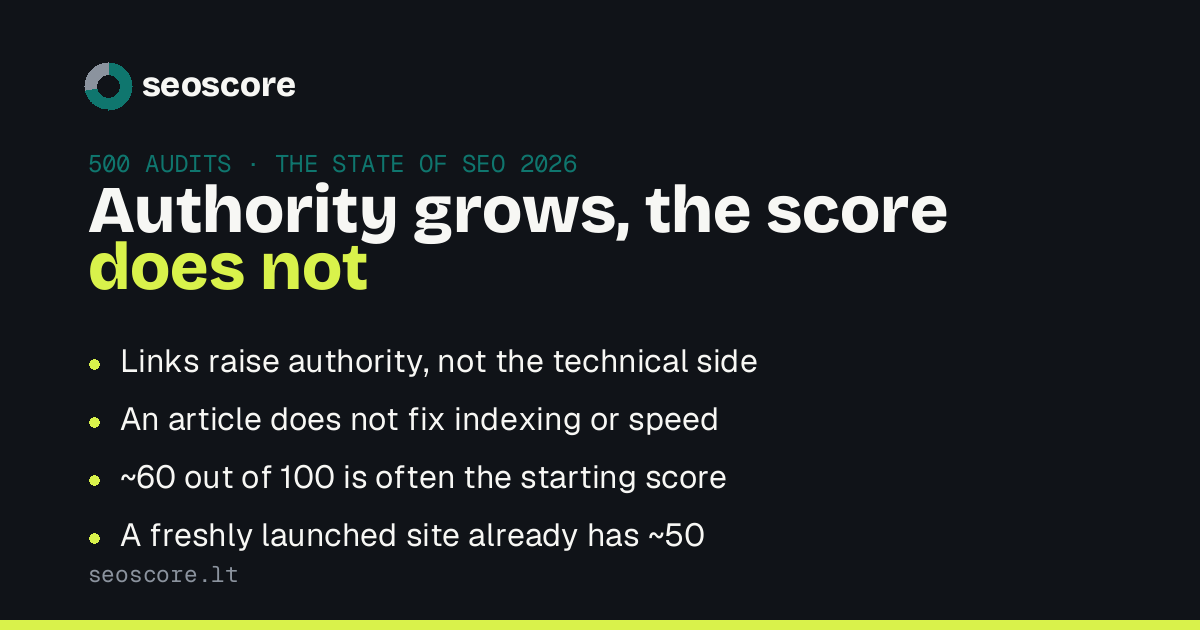
Across roughly 500 audits the same pattern repeats: a site with a strong link profile sits at about 60 out of 100 technically — roughly what it had on its first day. Links and articles raise authority but never touch indexing, speed, structured data or internal links.
Buying links and commissioning articles is not a scam — it still works. The problem is different: for many sites it is the only thing bought, and it covers far less than it appears to.
Where these numbers come from
We have run roughly 500 audits on our earlier platform. The exports from that work are no longer available, so what follows is not precise statistics but ranges and the patterns that kept repeating.
What that means for a reader: treat the numbers as a direction, not a measurement. Your own number comes from checking, and it always matters more than any average.
Where the money goes and where it never reaches
The usual picture: domain rating pushed to around half the scale, a dozen or so articles in the blog, a monthly invoice running into its second year. And a technical score of about 60 out of 100.
That happens because links and text answer two questions out of many:
- does anyone talk about you (authority);
- does the content cover the topic (coverage).
They answer none of these:
- whether the page gets into the index at all;
- how long it takes to load on a phone;
- whether
titleanddescriptionsurvive truncation; - whether structured data exists;
- whether internal links point at the pages that earn;
- whether two languages are linked both ways.
An article does not make a page faster. A link does not add hreflang.
Why the score sits where it started
A freshly launched, tidy site already scores about 50 out of 100. Not because
it is good — because a modern template does part of the work by itself: there
is a robots.txt, a sitemap, HTTPS and a mobile layout.
Which means something uncomfortable: if after two years of work the score is 60, ten points were actually earned on the technical side. Everything else that was paid for went into authority — and it did produce a result there, just not the one a technical audit measures.
This is not an argument for stopping link work. It is an argument for measuring the other half before paying for a third year.
What is usually critical on the technical side
In order of how often we find it and how much it costs:
Indexing. A page Google never accepted has neither a ranking nor a citation. "Discovered – currently not indexed" is the most common silent loss.
Speed on a phone. The desktop number looks fine, while real visitors arrive on mobile, where the same page takes several times longer.
Headings and meta. A title that is too short gets rewritten by Google, one
that is too long gets cut. Either way the result list shows something other
than what you wrote.
Structured data. Without it a page is text to a search engine; with it, an object that can be presented differently.
Internal links. Articles get written, but nothing connects them to the page that actually earns. The authority stays parked in the blog.
How to tell bought from fixed
There is one question worth asking your supplier: what part of this work would the site show with no external signals at all?
If the answer is "articles and links", the technical side is most likely untouched. That does not make the work bad. It makes it one-sided — and the other side does not need a monthly invoice: most critical items are fixed once.
Where to start
Measure first, buy second. A free scan shows the technical score and the findings holding it down — including the ones no link profile ever touches.
Then the same question on the other side: whether AI finds you at all. That is the subject of GEO in 2026, where the scores are usually lower still.
Related articles
- GEO in 2026: does AI find your site
- SEO or GEO: why you need both in 2026
- Technical SEO audit: what to check and when
- How much does SEO cost: the real ranges
How each item enters the score is described under what we check.
Sources
What this text is based on — primary sources, not retellings:
Frequently asked
Do bought links still work in 2026?
For authority, yes. Google's spam policies forbid exchanges whose only purpose is manipulating rankings, but the value of links has not gone anywhere. The question is not whether they work, but what they leave untouched.
Why is my score 60 after two years of paid SEO?
Because the technical score measures what is inside the site, while links and articles change what is outside it. Both are real, they are simply measured on different scales.
Can technical SEO be fixed once?
Most of it, yes. Headings, structured data, `robots.txt` and `hreflang` are fixed once and hold. Only indexing and speed need watching: every content or template change moves them.
Where to start on a small budget?
With indexing. A page that is not in the index gains nothing — not from links, not from content. It is the cheapest fix with the largest difference.
Check yours
A free scan shows which of the things described here your site already does, and which it does not.