What does a technical SEO audit actually cover?
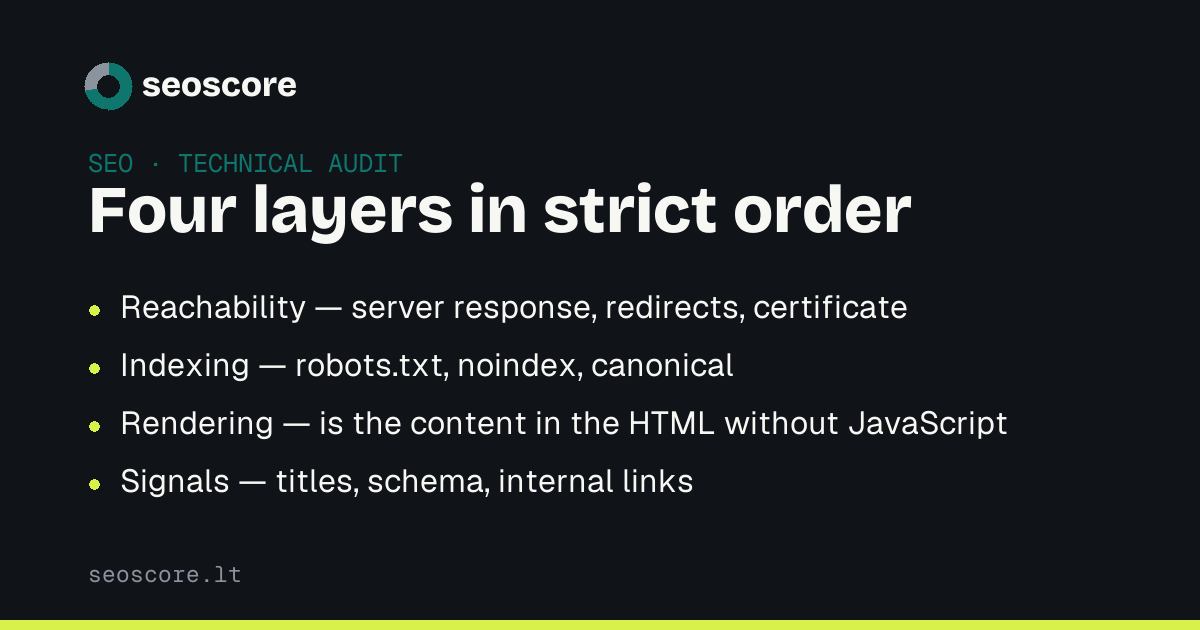
A technical audit checks whether a search engine can reach the page, read it, understand it and show it. Four layers run in strict order: server response, indexing rules, rendering with JavaScript, and only then titles, schema and internal link structure.
A technical audit is not a list of checks. It is four layers, and each one rests on the one below it. Find a problem in a lower layer and the upper ones stop mattering until it is fixed.
That makes the order the most important part of the audit.
Layer 1: is the page reachable
Before anything else — does the server answer, and what does it answer.
Checked: HTTP status, redirect chain, certificate validity, whether www and
https agree with the canonical address. Three redirects in a row is not an
error, but each one is lost time and a lost signal.
A common quiet fault is a page returning 200 instead of 404. Search then indexes hundreds of empty addresses and stops trusting the whole site.
Layer 2: is indexing allowed
This is where one-line mistakes cost entire pages:
- a
robots.txtrule closing what did not need closing; - a
noindextag that arrived together with the staging build; - a
canonicalpointing at another page, so this one counts as a copy; - an
hreflangpair with no answer from the other side — Google ignores such a group silently.
Important: a robots.txt disallow is not the same as noindex. Block
crawling and the address can still show up in results — just without a
description.
Layer 3: is the content in the HTML itself
Google does execute JavaScript, but in a separate, later pass. Most AI crawlers
do not execute it at all — to them an empty <div id="app"> is an empty page.
The check is simple: fetch the page without a browser and see how much text is left. If the main content is not in the server response, every later signal is measuring something the robot never sees.
Layer 4: signals
Only now does what most people call SEO begin: titles, descriptions, h1,
structured data, the internal link graph, sitemap dates.
This layer gives the most visible benefit — and the least, when the layers
below are broken. Perfect schema on a page with noindex is perfect schema
nobody will read.
When to repeat it
After every larger change — a migration, a redesign, a platform upgrade. In quiet periods, once a quarter is enough, plus a Search Console review once a month.
Related articles
The same subject from another angle — each answers its own question:
- How to fix SEO: a five-step plan
- Why Google does not index my pages
- Two languages and hreflang: getting it right
The full list of areas is under what we check.
Sources
What this text rests on — primary sources, not retellings:
Frequently asked
How is a technical audit different from a content audit?
The technical one answers "can this be shown", the content one answers "is it worth showing". The first is a precondition, the second is a reason. Without the first the second does not work; without the second the first gives nothing.
Do I need to check every page?
No. Faults almost always live in the template rather than an individual page, so one of each type is enough: home, category, product or service, article, contact.
What about findings I cannot fix?
Write them down and leave them. Some findings belong to the platform or the CDN, not to you. An instruction that cannot be carried out on your own site is worse than silence — which is why a good audit separates those out.
How long does a full technical audit take?
The automated part takes minutes. Manual review and decision-making takes half a day for a small site and several days for a large one.
Check yours
A free scan shows which of the things described here your site already does, and which it does not.