Where do you start when fixing a site's SEO?
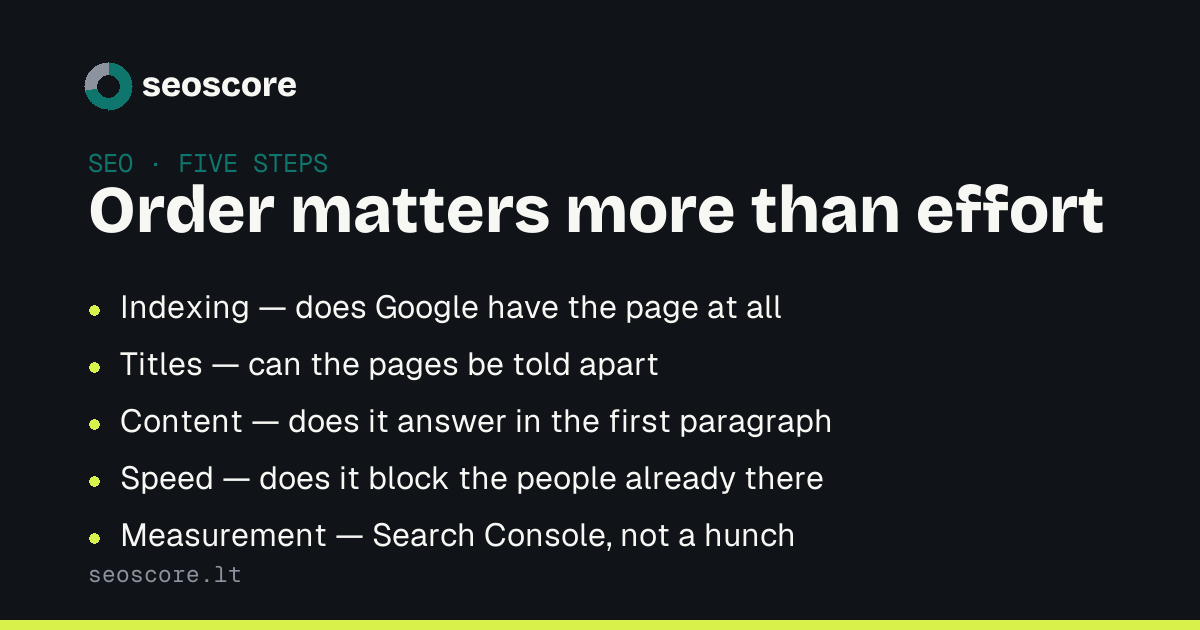
Start with indexing, not keywords. If Google does not have the page, nothing else has anywhere to work. The order is: are the pages indexed, do the titles tell pages apart, does the content answer the question, is speed getting in the way, and only then — are the numbers moving.
The most common mistake is not a bad title. The most common mistake is starting at step four: writing content for pages Google does not have in its index, or speeding up a page nobody finds.
So the plan is an ordered list, not a pile of tips.
1. Does Google see you at all
The first question is always the same: how many of your pages are indexed. The Search Console "Pages" report answers it — and it shows not just how many are indexed, but why the rest are not.
Three things stop everything else:
robots.txtblocking what did not need blocking;- a
noindextag forgotten after a move from staging; - a
canonicalpointing at another page, so this one counts as a copy.
All three are one-line mistakes, and all three cost a whole page.
2. Do the titles tell pages apart
<title> is not a place for keywords, it is a place for difference. When
five service pages all say "Services | Company", Google decides which one to
show, and often decides differently than you would.
The practical range: 50–60 characters including the brand suffix, brand at the end and once only. Description: 120–160. Too short and Google rewrites it itself; too long and it gets cut from the end.
3. Does the content answer the question
A page that opens with "in today's fast-moving digital landscape" loses twice: the reader leaves in three seconds, and a model looking for a quote takes the first paragraph under the heading and finds nothing in it.
Answer first, explanation after. That works for both the human and the machine, and it is the only style advice on this list.
4. Is speed getting in the way
Speed is not step one, because it affects people who already arrived. But once they have, it matters immediately: Largest Contentful Paint above 2.5 s means a share of them never saw the page at all.
The usual causes are boring, which is why they are fixable: unresized images, render-blocking scripts and a slow server response.
5. Are the numbers moving
Without measurement every step above is an opinion. The minimum set is Search Console (queries, positions, indexing) plus a repeat audit a month later, so you see a difference rather than a grade.
A score with no reference point is a grade. A score with the delta against the previous scan is a measurement.
Related articles
The same subject from another angle — each answers its own question:
- Why Google does not index my pages
- Title and meta description that Google actually shows
- Why is my website slow and where to start
How this feeds into the score is described under what we check.
Sources
What this text rests on — primary sources, not retellings:
Frequently asked
Where do I start if I only have one evening?
With indexing. The Search Console "Pages" report tells you in ten minutes whether the problem is even where you are looking. Writing content for a page Google does not have is work without an address.
Is buying links worth it?
No. Buying links is against Google's spam policies, and the risk lands on your domain, not the seller's. The same budget spent on content someone will cite by choice works more slowly and does not disappear.
How long until results show?
Technical fixes: days to weeks, once Google re-reads the page. Content and authority: months. Anyone promising a week either does not see the difference between those two things, or is counting on you not seeing it.
Do I need an SEO specialist?
Not for the first audit. Tools will give you the list of what to fix; the hard part starts where it means touching code or rewriting content. A specialist is worth it once you know what job you are handing over.
Check yours
A free scan shows which of the things described here your site already does, and which it does not.