How do I write a clear title and meta description?
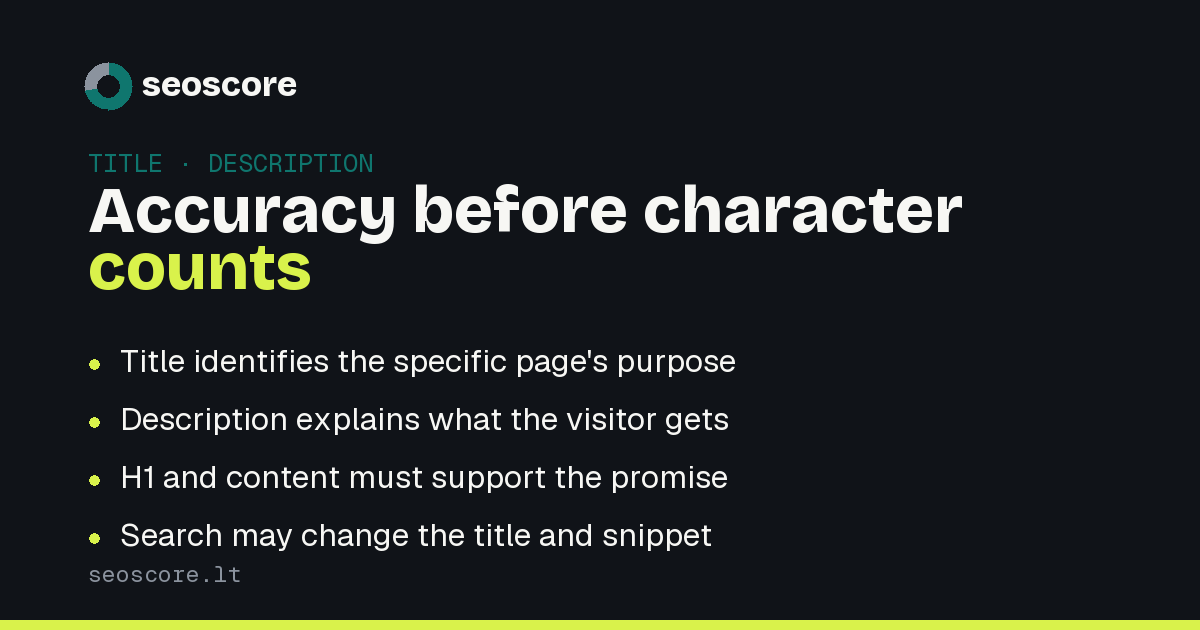
Write a unique title that identifies the page's purpose and a meta description explaining what the visitor will get. Keep both consistent with the H1 and visible content. Search engines choose their own result titles and snippets, so displaying your exact wording is not guaranteed.
Start with the purpose of the page
Before editing, write one sentence explaining which question the page answers or which action it enables. A tool page and a guide to using it can share vocabulary while making different promises.
Keep the title and H1 consistent
The title suggests a search result heading; the H1 is the main heading on the page. They do not have to be identical, but they should not promise different things. Avoid advertising a free audit on a page that only sells a paid consultation.
Repeated titles make pages harder to distinguish. They do not automatically mean only one URL will be indexed. Also consider content, canonical tags and the queries for which the pages appear.
A practical example
This educational example is for a page where a visitor can actually start a free scan:
<title>Free website SEO audit | Brand name</title>
<meta name="description" content="Check your website for technical SEO issues and get priorities for fixes. Review the free plan's scope before starting a scan.">
Adapt the title and description to the real offer. The word free should not conceal the fact that part of a report requires a paid plan.
How many characters to use
Roughly 50–60 characters for a title and 120–160 for a description can be editorial targets, not indexing rules. Display depends on the device, query and search engine. A short title is not automatically an error, and a longer one is not automatically penalized.
Why search changes the wording
Google may use the H1 or other page text for a title and assemble a snippet for the query. Even an accurate, unique title may be changed. Check whether the selected wording exposes a mismatch, but do not interpret every rewrite as a penalty.
How to evaluate the change
After editing, inspect the returned HTML and allow time for recrawling. Compare impressions, clicks and CTR for the same queries over comparable periods. Position, seasonality and result layout can also affect CTR, so a change cannot automatically be attributed to the description.
An SEO audit helps find missing or repeated tags. It does not predict which title Google or Bing will choose.
Related guides
Sources
Frequently asked
Is 60 characters a mandatory limit?
No. It is an editing target, not a technical rule or a guarantee of display.
Should English and Lithuanian versions have separate copy?
Yes. Each version should match its page and the vocabulary its audience uses.
Does a meta description guarantee more clicks?
No. It helps explain the page, but display and clicks depend on the query, position and competing results.
Check yours
A free scan shows which of the things described here your site already does, and which it does not.