How many websites are ready for AI search?
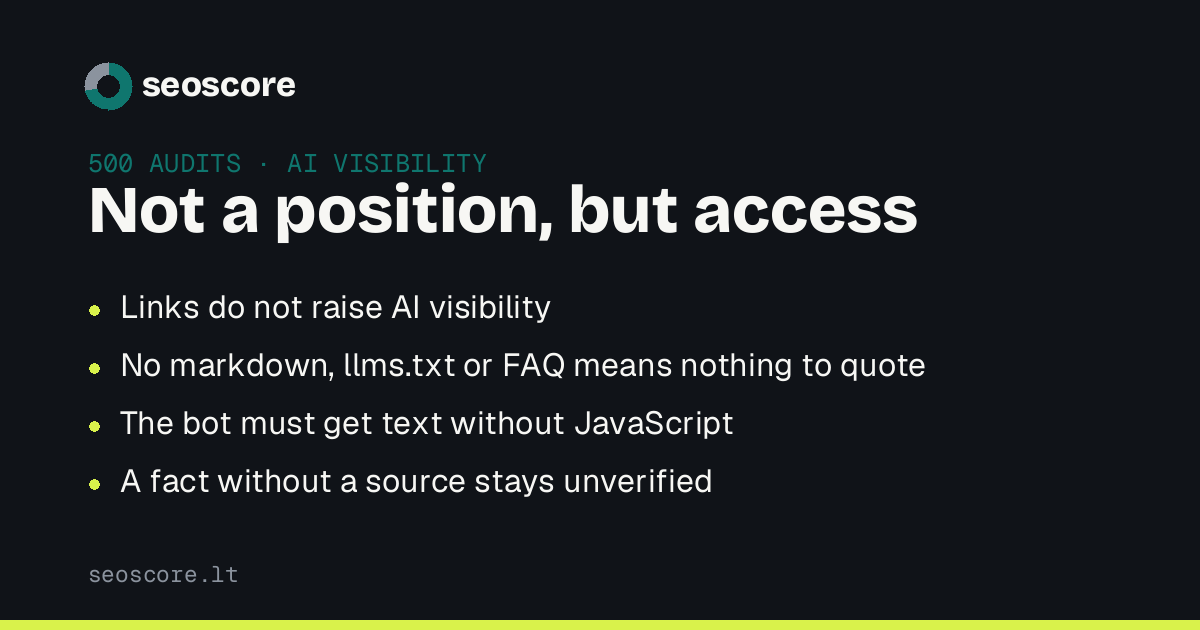
Usually not. Across roughly 500 audits the AI visibility side almost always stands lower than SEO. Four things are missing: a deliberate decision about AI bots, text without JavaScript, questions with answers, and verifiable facts. None of them can be bought — they are assembled inside the site.
A site can have a strong link profile, fifty articles, and still be close to invisible in ChatGPT, Gemini or Perplexity answers. These two sides are measured on different scales.
Where these numbers come from
We have run roughly 500 audits on our earlier platform. The exports from that work are no longer available, so what follows is not precise statistics but ranges and the patterns that kept repeating.
What that means for a reader: treat the numbers as a direction, not a measurement. Your own number comes from checking, and it always matters more than any average.
Why authority does not help here
A Google ranking is an ordering: out of ten suitable pages, one comes first. An assistant does not order anything — it assembles an answer from what it managed to read and verify.
So the question changes from "which place do you hold" to "can you be used at all". And domain rating says almost nothing about that.
The four barriers where it usually stops
Access. A robots.txt that never names GPTBot, ClaudeBot, PerplexityBot or
Google-Extended often lets them through by accident — or blocks them by
accident, along with everyone else. Either way it is a decision nobody made.
Text without JavaScript. If content only appears in a browser, the page looks empty to a bot. That is the most common reason a site "exists" and is still never cited.
A format for machines. Markdown negotiation (Accept: text/markdown) and
llms.txt are cheap and harmless, yet most sites have neither. No vendor has
publicly committed to reading llms.txt — it still costs one file.
Something to quote. A page that describes services but contains no question with an answer under it gives a model no passage to lift. It will not rewrite your text — it will take the text that is already an answer.
Why AEO is a separate job
Answer optimization — the question as a heading, the answer immediately below, no run-up — is the cheapest GEO work and most often the one left undone.
The practical test is simple: take your page and try to cut out three sentences that answer the question without context. If you cannot, neither can a model.
The same applies to facts. "Fast delivery" is not a fact. "Delivery in 1–2 working days" is, and it can be quoted without changing a word.
What this does to the score
In practice the GEO score runs lower than the technical SEO one — often around 40 out of 100 where SEO sits at 60. The reason is not negligence: nobody was assigned this work, because it is not part of any standard SEO package.
The good news is the same as on the SEO side: most of it is fixed once. The bad news is that a link budget does not help here at all.
Where to start
First check access and whether a bot sees any text. A free scan shows both at once, along with which pages have nothing to offer a citation.
The technical SEO side is covered in SEO in 2026, and how the two split a budget in SEO or GEO.
Related articles
- SEO in 2026: what is no longer enough
- SEO or GEO: why you need both in 2026
- What is llms.txt and do you really need it
- What is AEO and how to land in the answer
- Markdown for agents: a cheaper site for bots
How these items enter the score is described under what we check.
Sources
What this text is based on — primary sources, not retellings:
Frequently asked
Do links help you get into AI answers?
Indirectly. Models also draw on search results, so a completely invisible site gets cited less. But a link solves none of the four barriers: access, text without JavaScript, format, and something to quote.
Do I need `llms.txt`?
It is cheap and harmless, but no vendor has publicly committed to reading it. It matters more that `robots.txt` does not block AI bots and that your pages contain something worth quoting.
How quickly do GEO changes show up?
Technical changes — access, structured data — take effect from the bot's next visit, usually within a day or two. Content changes appear when the model refreshes its data, which can take weeks.
Is it worth blocking AI bots?
That is a separate decision with a price: block them and you get neither citations nor mentions. It makes sense only when the content is sold separately or is being copied by competitors.
Check yours
A free scan shows which of the things described here your site already does, and which it does not.