What do the sites scoring above 80 actually do?
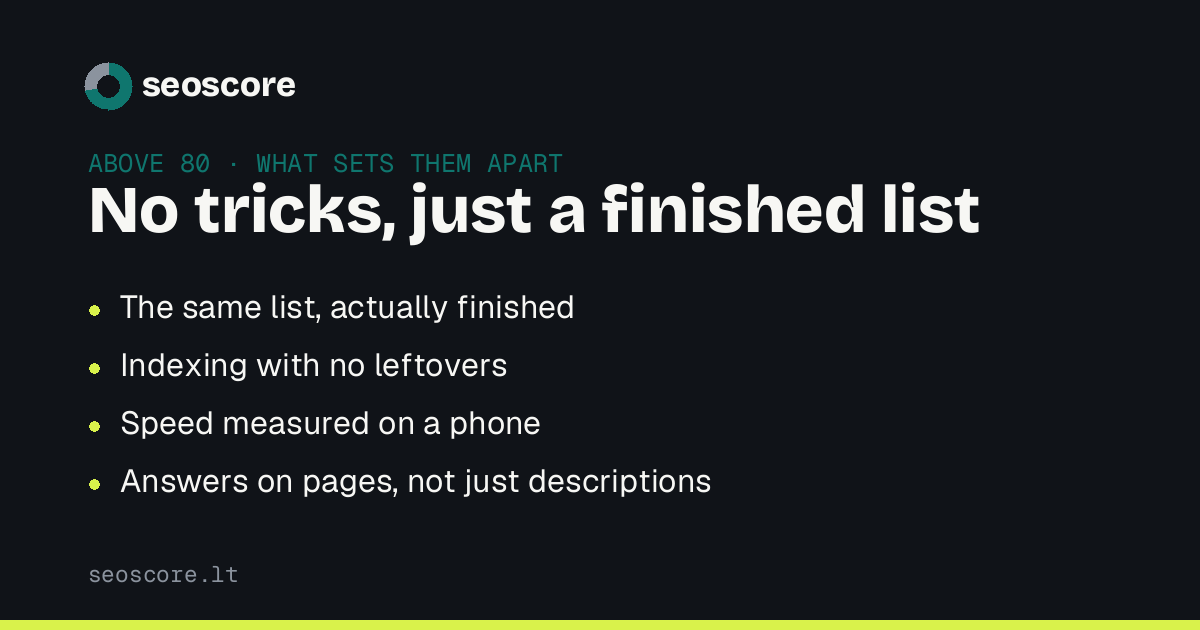
Sites above 80 points almost never use anything special. They completed the ordinary list: indexing with no leftovers, mobile speed, full structured data with author and dates, unique titles and descriptions, a deliberate robots.txt, and answers on the pages. What makes the difference is completeness, not budget.
It is easy to assume that high scores belong to people who know something others do not. In practice it is the reverse: they know the same things and did all of them.
The numbers draw on roughly 500 audits run on our earlier platform and on what we see today. The exports from that work are gone, so these are ranges rather than precise statistics.
What they have in common
Indexing with no leftovers. No several hundred "Discovered – currently not
indexed" in Search Console. The sitemap matches what actually exists, and
canonical points at itself.
Speed measured on a phone. Not the desktop number. Images in a modern format, with dimensions, and no third-party scripts nobody remembers the reason for.
Complete structured data. Organization with sameAs, BreadcrumbList on
every deeper page, Article with an author and both dates. Nothing exotic, and
nothing missing.
Unique titles and descriptions. Their own on every page, within the length limits, without the brand name twice.
A deliberate robots.txt. Only lines somebody can explain — including the
decision about AI bots.
Answers, not only descriptions. Pages carry questions with answers under them, and those answers contain numbers rather than adjectives.
What they do not do
Equally interesting:
- buy links as the only work;
- add schema where the page has no matching content;
- set
noindex"temporarily" and forget it; - keep an
llms.txtnobody updates; - optimise what nobody measures.
What it costs
Usually days of work rather than months — if the list is known and someone owns it. The most expensive part is normally speed, because it touches the template and the images.
So the key question is not "what will it cost" but "who will do it". A list without an owner stays a list.
Where to start
With your own number and its findings: a free scan. For comparison: what is typical and what to expect in your industry.
Related articles
- What score a typical website actually has
- What score to expect in your industry
- How the SeoScore 0–100 score is calculated
- How to fix SEO: a five-step plan
What gets checked is listed under what we check.
Sources
What this text is based on — primary sources, not retellings:
Frequently asked
Does every site need to be above 80?
No. A small one-page site needs to be indexable, fast and carry the basic data. A high score matters where visibility is genuinely contested.
How long does a high score hold?
The technical part holds until the template changes. Speed and indexing move on their own, so both are worth rechecking after any larger change.
Does a high score guarantee traffic?
No. The score says the site is not technically blocking itself. Traffic comes from demand and content; the score only stops standing in their way.
Where do I start if I am at about 50?
With indexing and mobile speed — they produce the largest change. Structured data and headings come next, because they are cheap and quick.
Check yours
A free scan shows which of the things described here your site already does, and which it does not.