What kind of pages does AI cite most often?
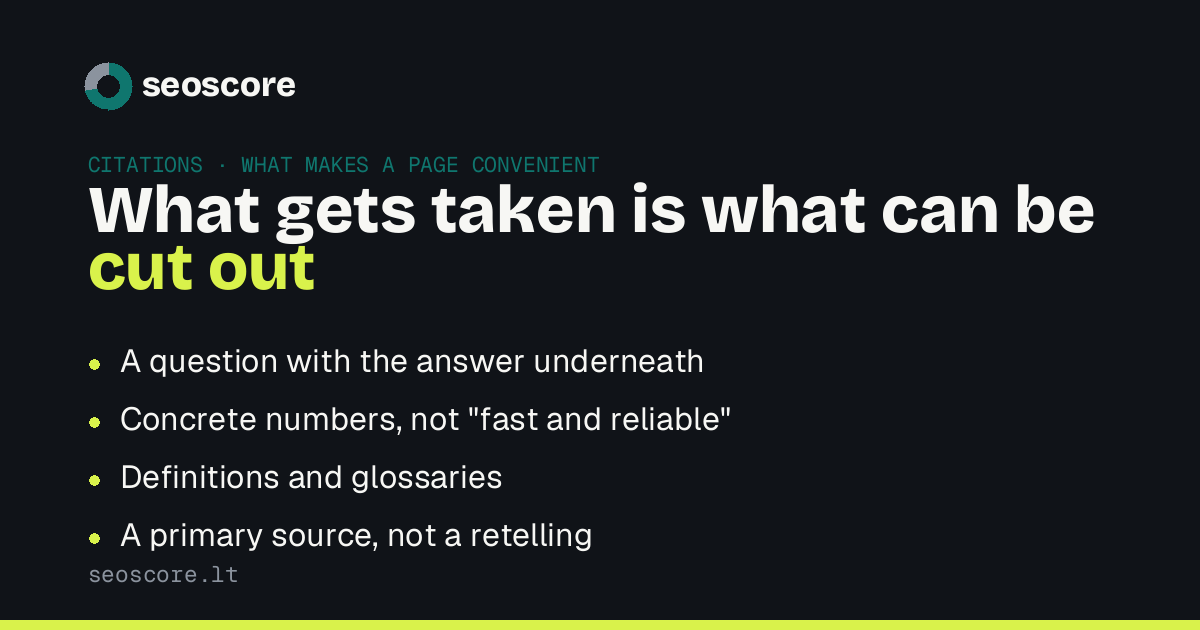
Four kinds of pages get cited most: a question with its answer directly underneath, pricing and terms with concrete numbers, definitions and glossaries, and primary documents. They share one property — you can take two or three lines out of them and those lines stay true without the rest of the page.
Citations do not go to the best written pages. They go to the ones that are easiest to take from. That distinction is the entire job.
The numbers draw on roughly 500 audits run on our earlier platform and on what we see today. The exports from that work are gone, so these are ranges rather than precise statistics.
The four kinds we see most
A question with the answer underneath. An FAQ where the question is a heading and the answer is the first sentence below it. To a model that is a ready-made passage that needs neither trimming nor rewriting.
Pricing and terms. Pages with concrete numbers: how much, in how many days, under what conditions. Such a claim can be quoted and linked, because it can be verified.
Definitions. "What is X" texts where the first sentence is the definition. Glossaries win here on form, not on length.
Primary documents. Rules, specifications, official pages. A model prefers the text closest to the source, and a retelling always comes second.
What almost never gets cited
- pages where the answer arrives after three paragraphs of run-up;
- texts without a single number or concrete claim;
- content that only appears after JavaScript;
- paragraphs you cannot understand without reading the whole page.
The last one matters most and is noticed least. If your sentence starts with "as mentioned above", it is immediately unusable as a quote.
A practical test
Take your page and try to cut out three sentences that stay true on their own. If you cannot, neither can a model — and the citation goes to whoever could.
A second test: does every claim carry a number or a source? You cannot quote "we deliver fast". You can quote "delivery in 1–2 working days".
What this changes in writing
Put the answer before the introduction. Make the question a heading rather than
bold text — a heading is a passage boundary, <b> is not. Write exact numbers
instead of approximations. And leave a link to the primary document: text with
corroboration is cited more often than text without.
Wider context: how AI chooses what to cite and GEO architecture.
A free scan shows which of your pages have nothing to offer a citation.
Related articles
- How AI chooses what to cite
- FAQ on a page: how to write one that answers
- What is AEO and how to land in the answer
- SEO and GEO numbers you can cite
What gets checked is listed under what we check.
Sources
What this text is based on — primary sources, not retellings:
Frequently asked
Are long articles cited more often than short ones?
No. What gets cited is a passage, not an article. A long text without headings is one large passage that is hard to take an answer from; a short text with clear headings offers several usable ones.
Do I need `FAQPage` schema to get an FAQ cited?
Not necessarily, though it does not hurt. What matters is the form itself — the question as a heading, the answer immediately below. Schema only confirms what is already visible.
Why is a competitor cited when my text is better?
Usually because theirs is easier to take: the answer is at the top, there is a concrete number, or a link to a source. That is form, not quality.
Should I only write short answers?
No. What works best is a short answer near the top and a fuller explanation below it — the first fits a citation, the second convinces the person who clicked through.
Check yours
A free scan shows which of the things described here your site already does, and which it does not.