How do internal links work and how do you lay them out properly?
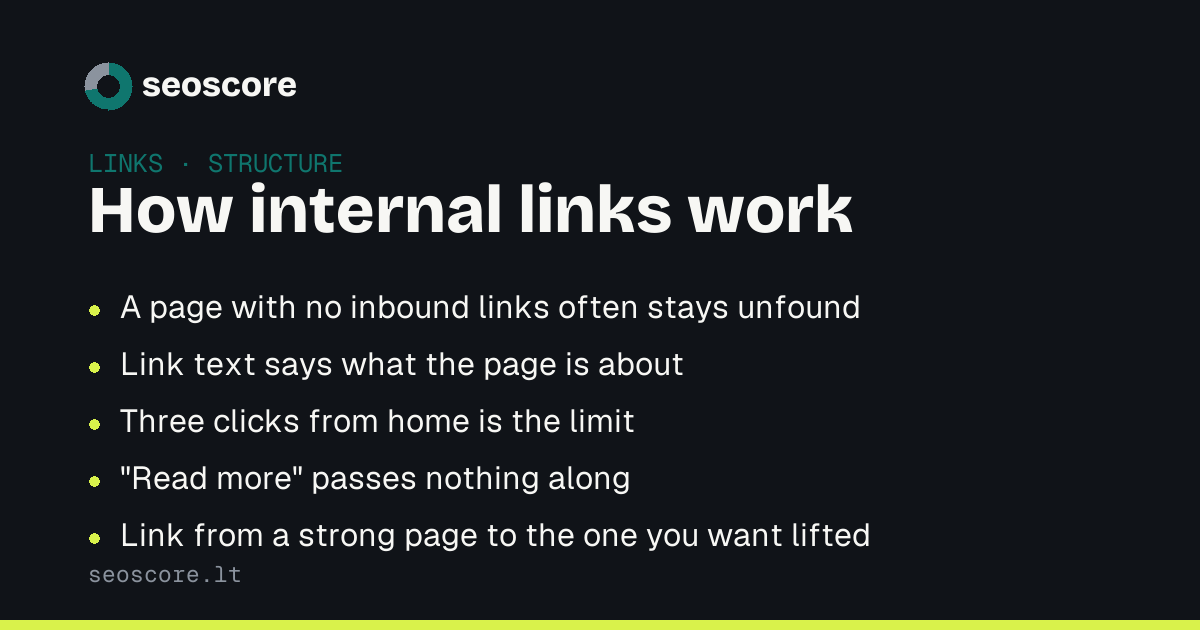
Internal links are links between your own pages. They do three things: show a crawler the route to a page, pass along a share of the site's authority, and describe what the target page is about through the link text. A page with no incoming internal links often goes unindexed entirely.
Internal links are the one ranking signal you control completely. External links have to be earned, the algorithm cannot be changed — but your own site structure can be reorganised in an afternoon.
And it is not a detail. A page with no internal links pointing at it often goes unindexed altogether, even when it sits in your sitemap.
What they actually do
They show the route. A crawler finds pages by following links. A sitemap states that a page exists, but the absence of links says the opposite thing: the site itself does not consider it important.
They pass authority. Part of the credibility a site earned externally travels inward along links. So your most important pages should be linked from your strongest ones, not parked in the footer.
They describe the target. Link text is a direct description. A link reading "technical SEO audit" says more than the page it points to, because somebody else wrote it — not the page about itself.
Link text: the one thing to get right
bad     More information can be found [here]
bad     [Read more]
good    [Technical SEO audit: what it covers]
"Here" and "read more" pass nothing along — not to a person scanning the page, not to a machine collecting signals. It is an empty link that costs exactly as much space as a precise one.
There is an opposite extreme too. Thirty links with identical "SEO audit" text does not read as structure, it reads as manipulation. Variation is natural: sometimes the full title, sometimes the topic, sometimes the question.
The three-click limit
From the home page to any important page should be no more than three clicks. This is not a rule from a specification but a practical consequence: the deeper a page sits, the less often it is crawled and the less authority reaches it.
In practice that means three levels:
home -> section -> page
An online shop with a thousand products needs more, and there categories with filters hold the line. But on a services site where the service page sits five levels deep, the problem is almost always navigation rather than volume.
Where to put them
Inside the text. A link within a paragraph is the strongest — it carries context around it. Footer links, present on every page, carry almost no weight precisely because they are everywhere.
From your strongest page to the one you want lifted. Check Search Console for the page with the most impressions. A link out of it costs one sentence and does more than ten new external links from nowhere.
In both directions. An article about AEO should lead to the one about GEO, and back again. A one-way link leaves the second page exactly where it was.
What not to do
Do not link every mentioned word. A page with forty internal links has no important ones — the weight divides into nothing, and the reader stops clicking them altogether.
Do not add a "related links" section for its own sake. Three genuinely related articles beat ten assembled by category.
Do not nofollow your own pages. It saves no authority and redirects
nothing — an obsolete tactic Google stopped reading the way people expected long
ago.
How to see your own structure
This is hard to judge from the inside: browsing your site feels well connected because you know where to go. What you need is a list of how many inbound links each page has.
The free scan builds an internal link graph — which page points where, how many links each one receives, and which pages are reachable from nowhere. That is where two or three completely forgotten pages nearly always surface.
Related articles
The same topic from another angle — each answers its own question:
- Why Google does not index pages
- Keyword cannibalization: competing with yourself
- sitemap.xml and robots.txt: what they do
How this feeds into the score is described under what we check.
Sources
What this text is based on — primary sources, not retellings:
Frequently asked
How many internal links per page?
As many as make sense in the text. Five to ten in a long article is normal; forty means half of them were not placed for the reader.
Do navigation links count?
Yes, but more weakly than links in body text. They appear on every page, so they single nothing out — and singling out is precisely the signal.
Do I need a "related articles" block?
Useful if it is genuinely related. A block generated automatically by category often leads to arbitrary pages, and then it says nothing at all.
Can internal links hurt?
They can — when two different links with the same text lead to two different pages. The site is then stating those pages are the same thing, and Google picks one.
Check yours
A free scan shows which of the things described here your site already does, and which it does not.