What is E-E-A-T and how do you show experience and authorship on a page?
E-E-A-T stands for experience, expertise, authoritativeness and trust, taken from Google's quality rater guidelines. It is not an algorithm signal but a set of criteria the algorithm tries to approximate. In practice it comes down to four visible things: an author, a date, sources, and facts nobody could write without having done the work.
E-E-A-T is four letters from Google's search quality rater guidelines: experience, expertise, authoritativeness and trust.
Start with what it is not. It is not a ranking factor — Google says so directly. The guidelines are written for the people who rate the quality of search results, and those ratings are used to improve algorithms, not to rank any particular page.
That does not make E-E-A-T irrelevant. There is no score for it, but the things it describes are either on your page or they are not. Raters are not the only ones who see them: so does the language model deciding whether to cite you.
The first E: experience
The newest letter and the one most often skipped. The question is simple: did the author do this, or only read about it?
Experience is not recognisable from the claim "10 years of experience". It is recognisable from details nobody has without the work:
without experience   "site speed matters to users"
with experience      "500 ms over budget cost a shop 7 % of its orders"
A model can quote the second sentence, because it contains a concrete figure. It will probably skip the first, having seen the same claim on hundreds of pages.
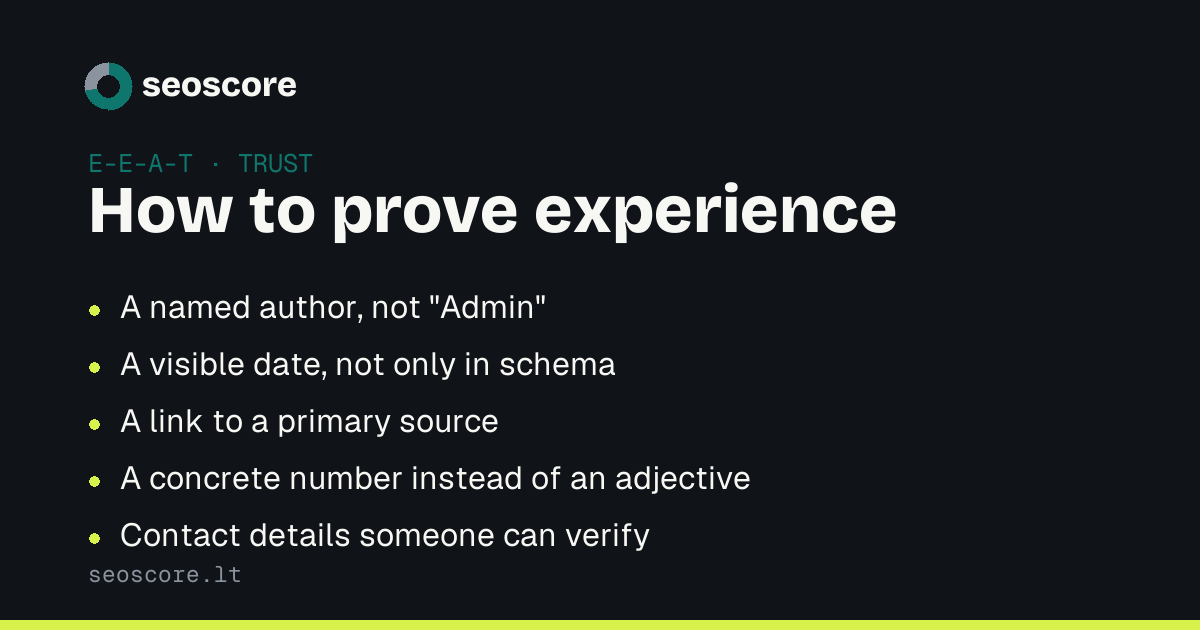
A simple rule while writing: every section gets at least one number, example or case you would not know without doing the job.
Expertise and authorship
A page with no author is a page nobody is accountable for.
A real name. Not "Admin", not the company name. A name someone can check.
A one-line introduction. A single sentence on why this person is the one writing this. A long biography is unnecessary — what is needed is the link between the person and the subject.
Person schema tied to Organization. In structured data the author is
referenced via @id, so that article, author and company form one graph rather
than three separate claims. How that works is under
structured data.
There is a limit. An author is required for text that claims something. A price list, a contact page or a product listing has no author and needs none — a list claims nothing.
Authoritativeness: sources
Text resting on nothing can only be verified by trusting it. Text with a link to a primary document can be verified in a second.
For GEO this matters most of all four letters. Choosing between two equally good paragraphs, a model takes the one whose claim it can confirm, because it is the one that carries the cost of a wrong citation.
Link to primary documents, not retellings. Google Search Central, not an article about Google Search Central. The specification, not a review of it.
Trust: the boring parts
The final T is the most important of the four, and it is built from things that do not look like SEO at all:
- contact details someone can verify — an address, a phone number, a real inbox;
- a visible publication date, and a separate updated date when it differs;
- HTTPS and sane security headers (why that is visible);
- prices and terms without asterisks;
- corrections made openly rather than deletions made quietly.
None of these lifts a ranking on its own. Together they are the difference between a site a model cites and a site it mentions without a link.
Where to start
Open your most important article and answer four questions: who wrote it, when, what it rests on, and what it says that nobody else could have written. If two answers are blank, that is your task list.
The free scan checks three of the four automatically: whether an author
is declared and whether the @id reference resolves, whether dates exist, and
whether long text carries at least one external source. The fourth — experience
— only a person can judge.
Related articles
The same topic from another angle — each answers its own question:
How this feeds into the score is described under what we check.
Sources
What this text is based on — primary sources, not retellings:
Frequently asked
Is E-E-A-T a ranking factor?
No. It is a set of evaluation criteria the algorithm approximates through other signals. So "improving your E-E-A-T score" is impossible — no such score exists.
Does every page need an author?
No. Pages that claim something do — articles, guides, advice. A price list or a product listing has no author and needs none.
Does AI-written text violate E-E-A-T?
Not in itself. Google judges the result, not the method. But AI text usually lacks precisely the first E — the experiential detail a model has nowhere to take from.
How do I show experience in a new field with no track record?
Through process, not seniority. A precise account of what you measured, how, and what came out is evidence of experience even from a single case.
Check yours
A free scan shows which of the things described here your site already does, and which it does not.