Why is an SEO audit in the local language more useful?
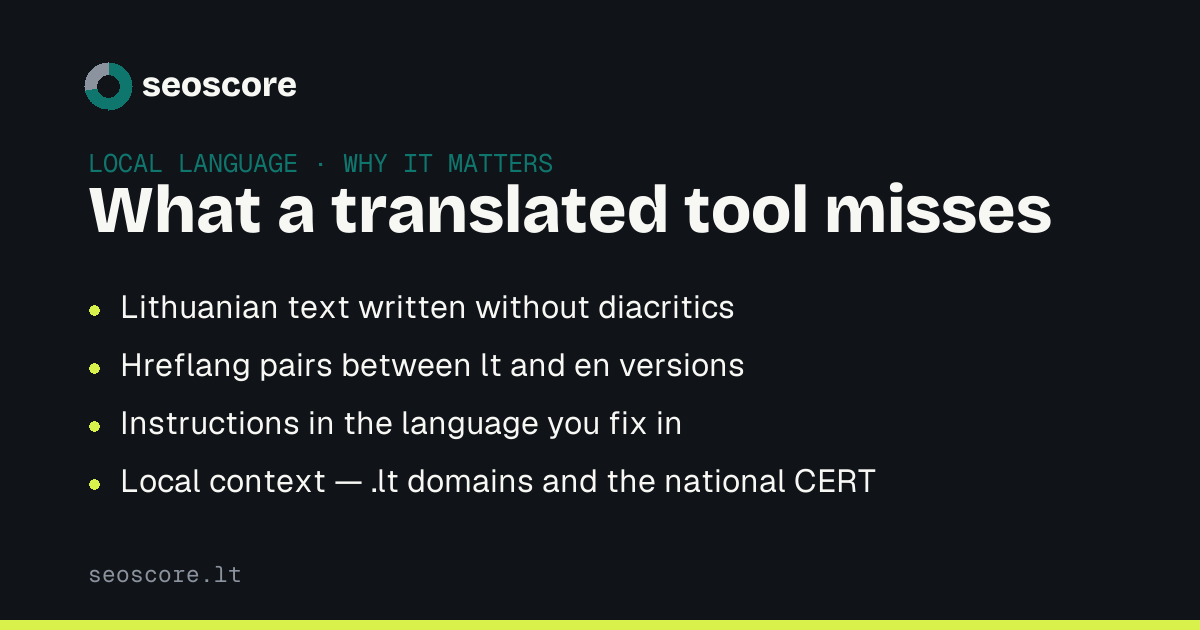
The difference is measurement, not translation. Lithuanian text written without diacritics, hreflang pairs between the Lithuanian and English versions, and local search competition are things an English-first tool either does not check or scores incorrectly.
Language here decides not convenience but what gets measured at all. A tool built for an English-speaking market measures part of a Lithuanian site incorrectly, and does not see another part at all.
Four concrete things.
1. Text without diacritics
"Uzklausos" and "užklausos" are two different words in a search index. A page where half the text is written without Lithuanian letters loses part of its matches — and reads as unprofessional to whoever is on it.
An English-first tool will never notice: to it both variants are simply text. This is not a theoretical example — such a finding turns up weekly.
2. Hreflang pairs
A Lithuanian site with an English version is the most common bilingual case. And
the most common fault is always the same: an hreflang declaration pointing at
the home page rather than at the second version of that same page.
Google only accepts a RECIPROCAL pair. A one-way declaration is ignored silently, and the two languages start competing with each other.
3. Instructions in the language you fix in
An audit is worth as much as what can be done from it. "Reduce unused JavaScript" and the same sentence in the reader's own language are the same finding, but the second one gets acted on immediately.
That matters most where the decision is not made by a developer: the owner, a marketer, a content editor.
4. Local context
A few things that are simply different:
.ltdomains and their DNS particulars;- a national cyber security centre tool that checks something other than a header audit;
- competition where the first page is local agencies rather than international directories.
What language does NOT change
Most technical rules are universal. canonical, robots.txt, LCP
and security headers behave identically in any language, and claiming otherwise
would be marketing.
The difference is in the four things above — and those are exactly the ones that usually go unchecked.
Related articles
The same subject from another angle — each answers its own question:
- Two languages and hreflang: getting it right
- Free SEO scan: what it actually shows you
- Automated SEO audit: where software wins
The full list of areas is under what we check.
Sources
What this text rests on — primary sources, not retellings:
Frequently asked
Are foreign tools unsuitable?
They suit the technical half, and often do it well. They do not suit the parts needing local-language judgement and bilingual pairs — there they either stay silent or get it wrong.
Do I need separate content in each language?
Yes, if you want both markets. Machine translation without editing usually produces text that is technically correct and untrustworthy to a reader — and trustworthiness is what decides whether search engines and models rely on the page.
Does a `.lt` domain help in Lithuania?
It helps as a regional signal, but it does not replace content language and local context. Google looks first at the language itself and at `hreflang`.
What if the site is Lithuanian only?
Then no `hreflang` is needed at all. Declaring an alternative that does not exist is worse than declaring none — Google treats such a pair as an error.
Check yours
A free scan shows which of the things described here your site already does, and which it does not.