When is an automated SEO audit better than a manual one?
Automation wins where a check is a rule and repeats: indexing, titles, links, speed, schema. A person wins where judgement is needed — about topics, copy and priorities. The worst option is doing by hand what a machine does more accurately.
The "automation or specialist" argument is almost always framed wrongly. The question is not which is better, but which part of the work is a rule and which is a decision.
Rules belong to the machine. Decisions belong to the person.
Four things a machine does better
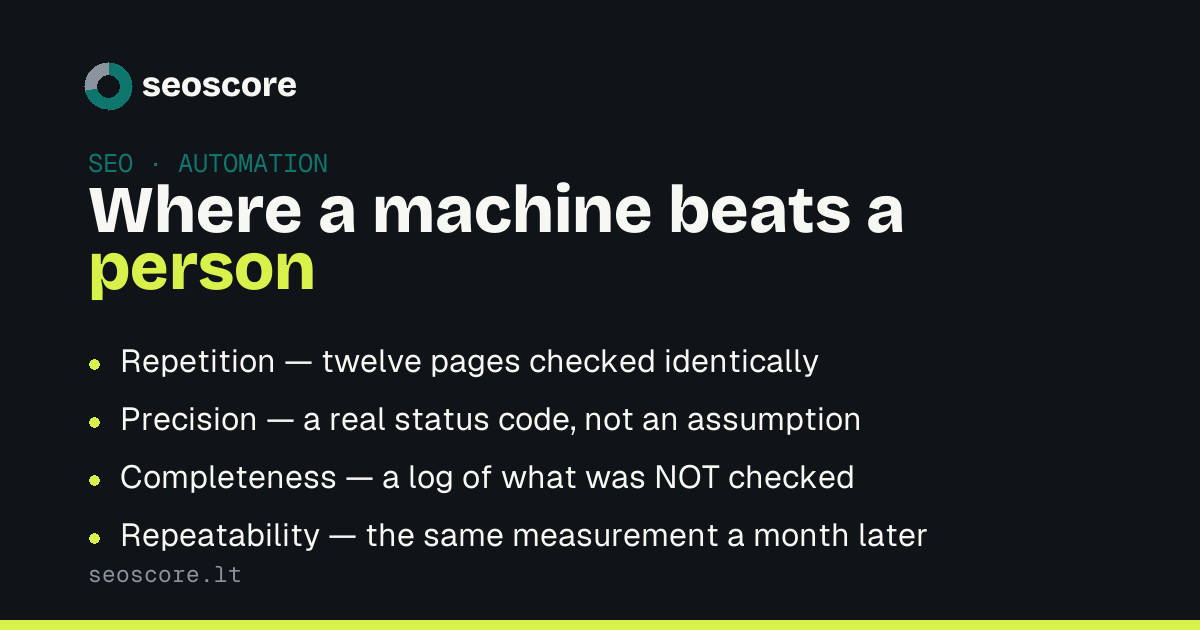
Repetition. Checking whether twelve pages have an h1 is, for a person,
twelve identical actions — the last few done without much attention. For a
machine, twelve and twelve thousand differ only in duration.
Precision. "The link looks fine" and "the link returned 200" are two different statements. An audit is worth as much as the evidence in it, and evidence means a real status code, a real byte count, a real measurement.
Completeness. A check that never ran looks exactly like a check that ran and passed: in both cases there is no line on screen. A report has to answer "what did you not check" — and no person writes that list about themselves.
Repeatability. A month later the same measurement gives a difference rather than a fresh opinion. That difference is the only proof the work did anything.
Three things a machine will not do
Priorities driven by the business. A scanner will rank findings by search impact. Whether your service page matters more than your blog depends on where your revenue comes from — and no data in the HTML says that.
Copy that sells. The length of a headline can be measured. Whether it convinces cannot.
Context. A score without competitors is a grade. Judging a market takes a person who can see that market.
Where the line usually gets crossed
The common mistake is not too much automation but too little: an agency billing by the hour for what a scanner does in two minutes, more accurately. The opposite mistake is trusting the score as a verdict and fixing everything in order, without asking whether it matters at all.
The healthy split is simple: the machine gives the list and the evidence, the person decides the order.
Related articles
The same subject from another angle — each answers its own question:
- Free SEO scan: what it actually shows you
- Technical SEO audit: what to check and when
- How to fix SEO: a five-step plan
How this turns into a score is described under what we check.
Sources
What this text rests on — primary sources, not retellings:
Frequently asked
Can an automated audit be wrong?
Yes, in two ways. First, it misses what needs context. Second, and more dangerously, it reports a finding that is not real — treating a listing page as an article, say, and complaining about a missing author. That is why every finding has to show its evidence, not just its name.
How do I tell whether a tool can be trusted?
Look for a specific address and a specific number next to each finding. A finding without evidence is an opinion with an icon.
Do I need a paid tool?
For the technical half, often not. Paying is worth it when you need history: watching the same domain change across months is a different product from a one-off check.
How often should I scan?
After every larger change, and once a month in quiet periods. More often has no point: most changes in search are not visible immediately.
Check yours
A free scan shows which of the things described here your site already does, and which it does not.