Why did my organic traffic from Google drop and how do I find the cause?
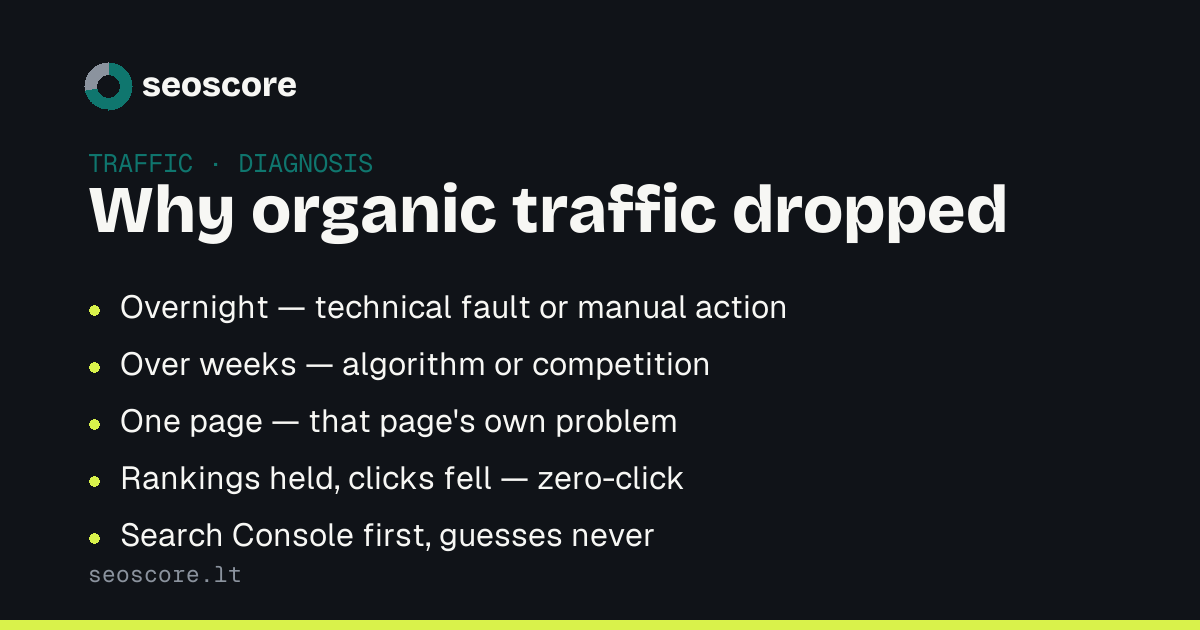
Organic traffic drops have four distinct causes, and the shape of the fall separates them. An overnight collapse means a technical fault or a manual action. A gradual slide over weeks means an algorithm update or a competitor. One page falling alone means a problem with that page. Rankings holding while clicks fall means zero-click search.
Traffic fell, and the first instinct is to start fixing everything at once. That is the most expensive route available: half the changes do nothing, and along the way you lose any chance of understanding what actually happened.
The first step is not a fix but identifying the shape of the drop. It tells you where to look.
Four shapes, four causes
| What the graph shows | What it almost always means |
|---|---|
| Vertical drop over 1–2 days | Technical fault or a manual action |
| Gradual slide over 2–8 weeks | Algorithm update or a competitor |
| One page fell, the rest held | That page's own problem, or cannibalisation |
| Impressions steady, clicks down | Zero-click search or AI answers |
Take the graph from Search Console, not Analytics. Analytics shows who arrived; Search Console also shows how often you were shown. The gap between impressions and clicks is half the diagnosis.
Vertical drop: a technical fault
Traffic does not fall overnight "because of the algorithm". Overnight it falls because somebody changed something.
In order of frequency:
robots.txt blocks too much. A single Disallow: / left behind after a
push from staging closes the entire site.
noindex shipped to production. The same story at page level. WordPress has
a dedicated "Discourage search engines" switch — turned on while building,
forgotten afterwards.
Redirects after a migration. A new design with new URLs and no 301s from
the old ones. Google sees a hundred 404s and the history goes nowhere.
Server or certificate. A site down for a few days leaves the index quickly and comes back slowly.
A manual action. Search Console → Security and manual actions. If that page is empty, this option is off the table.
All five can be checked in ten minutes, and four of them are visible with no
tooling at all — open /robots.txt and view the page source.
Gradual slide: algorithm or competition
If the fall stretched over weeks, stop looking for technical faults. Look for a date.
Google announces core updates publicly with exact start and end dates. If your drop lines up with one of them, the cause is not on your server.
But it matters what an update actually does. It does not punish — it reorders. Your page did not get worse; another page was judged more valuable. So the response is different too: not "what do I fix", but "what is missing from my text compared with the one now ranking first".
If no update ran on those dates, competition is what is left. That is checked directly: look at who now occupies the positions you used to hold.
One page: usually cannibalisation
When one page falls while the rest of the site holds, the cause is almost always local. Most often two of your own pages compete for the same question, and Google changed its mind about which to show.
That is a topic of its own, covered under keyword cannibalization.
The second most common cause is that the page was edited. Text shortened, a
title changed, a section removed. Search Console shows the exact date the
clicks changed; compare it against your content history.
Rankings hold, traffic does not
This is the newest and now the most common shape. Impressions stay flat or even grow while clicks keep falling.
It means one thing: people are getting the answer without clicking. A Google featured snippet, AI Overviews, or a ChatGPT conversation that drew on your page without the person ever opening the link.
Classic SEO stops answering here, because the unit of measurement changed. How to measure it and what to do about it is under AI search and traffic.
What not to do
Do not change everything at once. Five simultaneous changes mean that in a month you will not know which helped and which hurt.
Do not wait for it to come back by itself. A technical fault does not heal, and the longer a page returns 404, the less history survives.
Do not rewrite the content on day one. Text is the last suspect, not the first: it did not change on the night the traffic fell.
The free scan checks the technical side in a couple of minutes — indexing blocks, redirects, broken links and speed. That closes the first section of the list, leaving only content questions behind.
Related articles
The same topic from another angle — each answers its own question:
- Why Google does not index pages
- Keyword cannibalization: competing with yourself
- AI search and traffic: what is changing
How this feeds into the score is described under what we check.
Sources
What this text is based on — primary sources, not retellings:
Frequently asked
How long until traffic returns after a technical fault?
From a few days to a few weeks, depending on how quickly Google re-reads your pages. A sitemap with accurate `lastmod` dates speeds that up.
Can seasonality look like a drop?
Yes, and it is the first thing to rule out. Compare with the same period last year, not with last month.
Is it worth contacting Google after a penalty?
Only after a manual action, and only once the cause is fixed. For an algorithm update there is nowhere to appeal — no such mechanism exists.
Analytics shows a drop, Search Console does not. Why?
Usually a measurement fault: a changed Analytics tag, a consent banner, or a blocked script. Search Console data comes from search itself and does not depend on your scripts.
Check yours
A free scan shows which of the things described here your site already does, and which it does not.