Which structured data is actually used, and where does it go wrong?
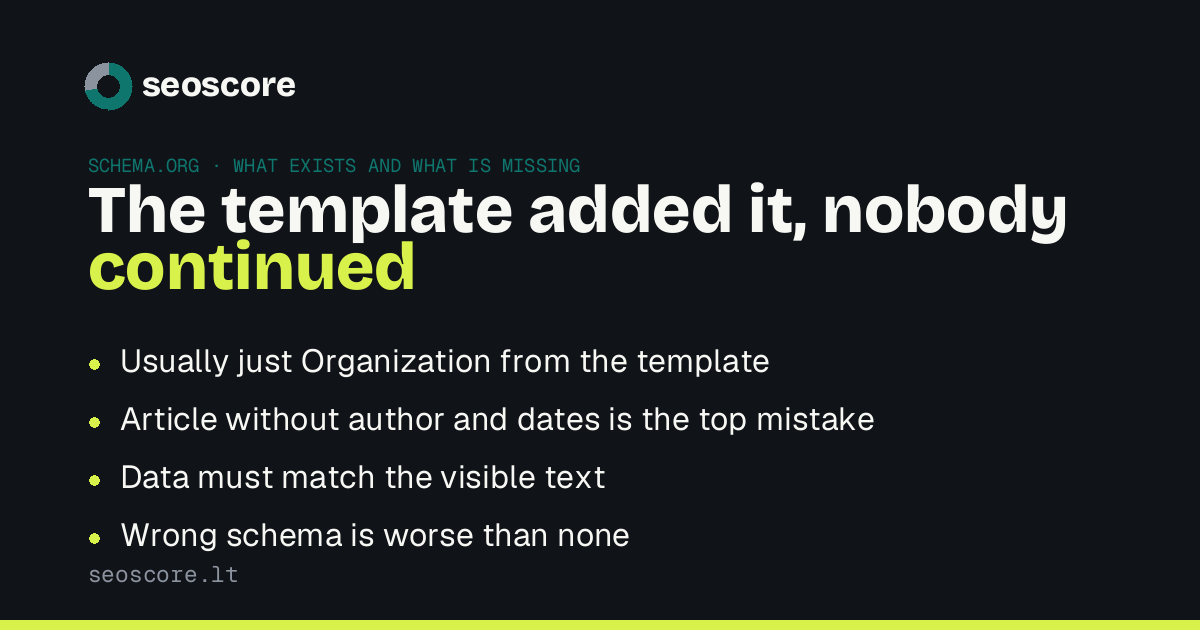
In practice we see two extremes: either no structured data at all, or a template Organization node and nothing else. The mistakes are consistent too — data that does not match what the page shows, Article without an author or dates, Product without a price or availability, and FAQPage on a page that has no FAQ.
Structured data is one of the few things you can add in a day and see work straight away. Which makes it interesting that in practice its state is almost always the same.
The numbers draw on roughly 500 audits run on our earlier platform and on what we see today. The exports from that work are gone, so these are ranges rather than precise statistics.
What we see most often
Organization, added by the template. A name, sometimes a logo. No sameAs,
no contact details, often a wrong url. Better than nothing, but it stops at
step one.
Article with nothing in it. Articles marked as Article but missing
author, datePublished and dateModified. This is the single most common
mistake, and those three fields are exactly what decides whether a text looks
trustworthy.
Product without a price. Shops do carry Product, but offers is missing
price, priceCurrency or availability — which is the whole reason the node
is there.
FAQPage without an FAQ. Rarer but worse: the schema declares questions the page does not contain. That is not an omission, it is a false statement.
Why a mismatch is worse than a gap
Google's guidance is explicit here: structured data must describe what is visible to a person on the page. A node that says something the page does not show is grounds for losing rich results altogether — not only on that page.
So the order is: text first, schema second. Never the other way round.
What an ordinary site actually needs
A short list that captures most of the value:
- Organization — once, on the home page, with
sameAspointing at real profiles; - WebSite — if you have site search;
- BreadcrumbList — on every deeper page, with labels matching the visible breadcrumb;
- Article — for articles, with an author and both dates;
- Product with
offers— if you sell; - FAQPage — only where an FAQ genuinely exists.
Everything else is optional and usually adds nothing this list does not.
How to check
The fastest route is Google's Rich Results test for one page and the Search Console report for the whole site. A scan does the same across every page at once and shows where a node exists but is incomplete.
Wider context on which types are worth having: structured data.
Related articles
- Structured data: which types you actually need
- What score a typical website actually has
- FAQ on a page: how to write one that answers
- E-E-A-T: showing experience and authorship
What gets checked is listed under what we check.
Sources
What this text is based on — primary sources, not retellings:
Frequently asked
Does structured data raise rankings?
Not directly. It changes how a result looks and helps a machine understand what is on the page. Click-through often improves; the ranking itself is decided by other things.
Can one page carry several nodes?
Yes, and often it should: `BreadcrumbList` plus `Article` plus `FAQPage` on the same page is normal, as long as all three match the content.
Which is worse — no schema or wrong schema?
Wrong schema. Missing schema is a lost opportunity; wrong schema is a false statement to a machine, and it is paid for with a loss.
Is JSON-LD better than microdata?
In practice yes. Google recommends JSON-LD, and it is easier to maintain because it lives in one place instead of being scattered through the HTML.
Check yours
A free scan shows which of the things described here your site already does, and which it does not.